Architecture and Fashion

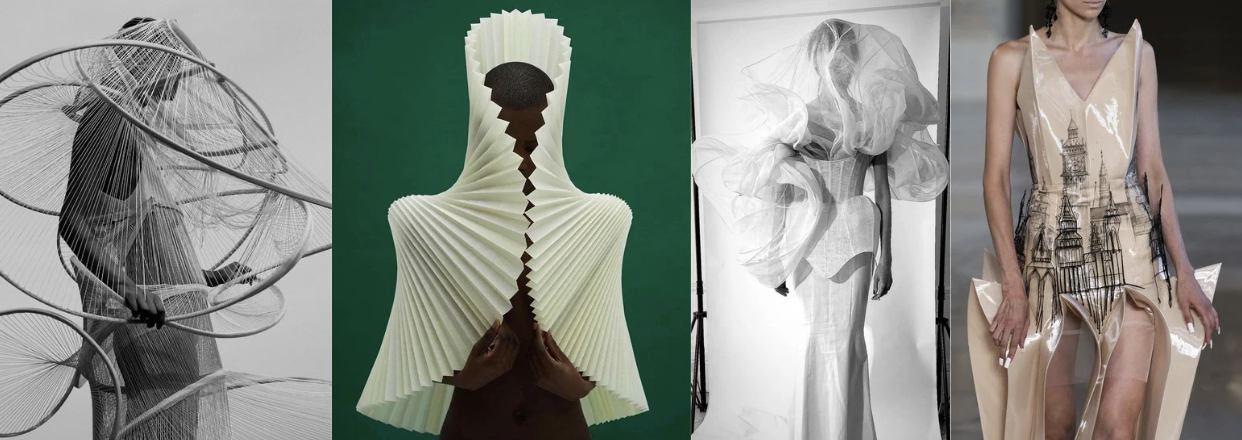
Architecture and fashion are often perceived as distinct creative fields, yet they originate from the same fundamental human necessity: shelter. Fashion protects and adorns the individual body, while architecture shelters communities and shapes collective life. Across history, both disciplines have evolved as powerful forms of expression, reflecting social, economic, political, and artistic movements. While fashion tends to be more immediate, reactive, and rebellious, architecture is generally slower, more monumental, and rooted in long-term structures. Despite these differences, both respond to societal change and create paradigmatic moments that define eras.
Modern architecture has become a major source of inspiration for fashion designers, influencing silhouettes, materials, and construction techniques. Likewise, fashion has pushed architecture to become more experimental and pliable. Through technology such as 3D printing, parametric software, and material innovation, architects and designers now follow remarkably similar creative processes: transforming a two-dimensional concept into a three-dimensional reality.
Architecture and Fashion as Creative Practices
At their core, architecture and fashion share the same creative logic. One can be defined as “the art and technique of designing and constructing buildings,” while the other becomes “the art and technique of designing and constructing clothes.” Both exceed these definitions through their functional and symbolic roles.
Traditionally, both disciplines respond to human needs and artistic desires. Architecture shelters multiple bodies and organizes space for living, working, and gathering. Fashion shelters the individual body, mediating between intimacy, identity, and public display. In this sense, they operate at different scales but share the same purpose: to protect, express, and communicate.
A Shared Design Language: Skin, Frame, and Structure
Architecture and fashion rely on a shared technical vocabulary: skin, frame, model, construction, material, and structure. These concepts were notably explored by Brooke Hodge in the exhibition Skin + Bones, which highlighted how architectural principles translate directly into fashion design.
The idea of skin is particularly revealing. In architecture, the façade acts as the building’s skin; in fashion, fabric becomes a second skin for the body. This parallel has been explored through the work of artists such as Christo, whose large-scale fabric installations blur the boundary between clothing and architecture, wrapping buildings and landscapes as if dressing them.
As social values and technologies evolve, these definitions shift. Both fields are deeply influenced by art movements, cultural change, and trends, constantly redefining their relationship to the body and space.
Historical Overlaps: From Teepees to Modernism
The relationship between architecture and fashion dates back to the earliest forms of shelter. The teepee, for example, combined animal skins as a literal architectural skin with wooden poles as a structural frame. While not fashion in a modern sense, these animal skins later inspired fashion trends such as animal prints, seen in contemporary collections by houses like Dolce & Gabbana, Balmain, and Ganni.
By the 1930s, technological progress introduced materials like nylon and polyester, revolutionizing both tent construction and clothing. This evolution reflects a broader concept explored in Parallel Practices in Fashion and Architecture by Brooke Hodge and Patricia Mears, particularly focusing on the 1980s, a decade that highlighted the shared intellectual principles uniting both fields (Hodge, 2007).
Fashion in Architecture: When Clothing Inspires Buildings
- Art Nouveau (Late 19th – Early 20th Century)
- Art Nouveau architecture embraced organic forms, flowing lines, and natural motifs. This aesthetic mirrored contemporary fashion, characterized by fluid silhouettes and decorative frills. A key example is Casa Batlló by Antoni Gaudí, where architectural curves echo the softness and movement of period garments.
- Art Deco (1920s–1930s)
- Art Deco introduced geometric patterns, symmetry, and luxurious materials. This visual language was reflected in both fashion and architecture. The Chrysler Building in New York exemplifies this style, with its streamlined form resembling the structured silhouettes of 1920s fashion.
- Postmodernism (Late 20th Century)
- Postmodern architecture rejected the rigidity of modernism, embracing fragmentation, irony, and historical references. At the same time, avant-garde fashion designers like Rei Kawakubo (Comme des Garçons) deconstructed traditional garments. Architects such as Frank Gehry echoed this approach through fragmented, sculptural buildings.
- Digital Age and Parametricism (21st Century)
- With computational design, architecture has entered a new era of fluid, organic forms. Zaha Hadid’s work exemplifies this shift, paralleling the experimental fashion of designers like Alexander McQueen and Iris van Herpen, whose garments appear almost architectural in structure.
Architecture in Fashion: Building the Body
- Structured Silhouettes
- Fashion designers, like architects, construct form. Tailored jackets, sculptural dresses, and geometric garments reflect architectural thinking, emphasizing precision, balance, and structure.
- Unconventional Materials
- Just as architects experiment with glass, metal, and concrete, fashion designers integrate PVC, metal mesh, recycled plastics, and industrial textiles into garments, blurring the line between wearable and built form.
- Space and Volume
- Fashion manipulates volume and negative space much like architecture. Through draping, folding, and pleating, designers create garments that redefine the body’s relationship to space.
Architects in Fashion Spaces
Architects frequently shape the fashion world through retail and exhibition design. James Wines, for instance, designed garments, retail spaces, and offices for WilliWear, bringing the street into fashion through deconstructed architectural interiors. Similarly, Frank Gehry’s design for the Issey Miyake flagship store demonstrates how architecture enhances the fashion experience.
Luxury brands increasingly collaborate with star architects to design flagship stores that function as immersive brand environments, transforming shopping into a cultural and spatial experience.
Limits and Critiques of the Architecture–Fashion Fusion
Despite its creativity, this fusion has limitations. Architectural fashion can become unwearable, prioritizing spectacle over comfort. Similarly, highly experimental architecture may sacrifice functionality or sustainability. There is also the risk of elitism, where these cross-disciplinary creations remain inaccessible to the wider public.
Sustainability presents another challenge. While both fields strive for eco-friendly solutions, experimental materials and technologies can be costly and difficult to scale responsibly.
My Thought
For me, the relationship between architecture and fashion is not just about aesthetics. It is about how we inhabit the world. Clothing is the closest space we occupy, while architecture is the largest. Seeing how these two disciplines influence one another helps me understand design as a continuum rather than separate categories. Their dialogue shows that creativity thrives when boundaries dissolve, even if it means embracing experimentation, failure, and limitation along the way.
See you in the next one,
Xoxo
Eden
Resources
Websites:
- Interior Educator: https://interioreducators.co.uk/uploads/submitted-files/219.WA_.2023_02_.pdf
- JD Institute of Fashion Technology: https://www.jdsd.in/fashion-and-architecture-creating-structural-wearables/
- Articles of Interest – Architecture and Fashion: https://articlesofinterest.substack.com/p/architecture-and-fashion
- Yellowbrick – Fashion & Architecture: https://www.yellowbrick.co/blog/fashion/fashion-architecture-exploring-the-influence-in-design
Images References
- Photo 1: https://i.pinimg.com/736x/01/f6/fe/01f6fe9c773195bb0d88edad58aa9273.jpg
- Photo 2: https://i.pinimg.com/1200x/e4/d4/d4/e4d4d4596bea47a73a0ce8125a081e8e.jpg
- Photo 3: https://i.pinimg.com/736x/c2/08/ee/c208eea27dffb85f5f80dea598ab35ec.jpg
- Photo 4: https://i.pinimg.com/1200x/a9/09/66/a909668366dbdcd2faad9a516edeccbb.jpg