Dior SS26 Haute Couture

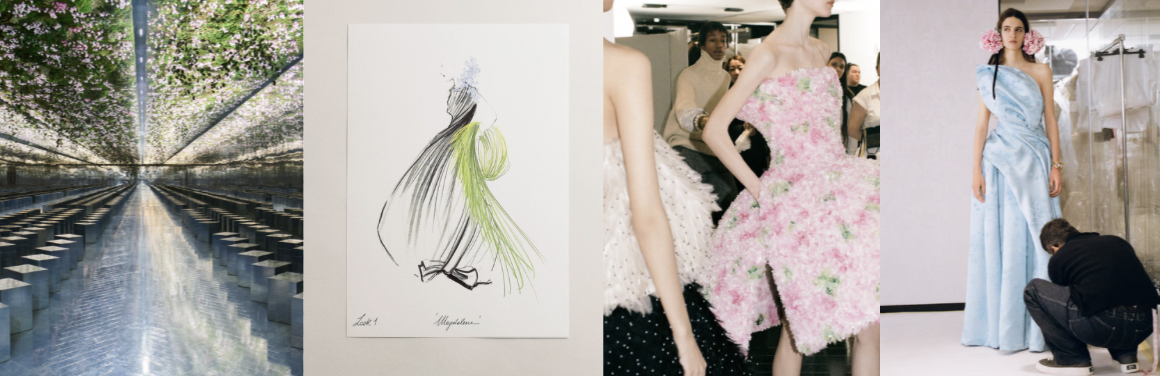
Jonathan Anderson’s first haute couture collection for Dior arrived with a sense of déjà-vu and disruption. Presented in the same mirrored tent used for his recent menswear show at the Musée Rodin, the event drew an elite crowd, including Rihanna, Jennifer Lawrence, Anya Taylor-Joy, Greta Lee, Taylor Russell, Josh O’Connor, and Brigitte Macron, alongside LVMH CEO Bernard Arnault. Notably, John Galliano attended his first Dior show since leaving the house in 2011, a symbolic full-circle moment.
What unfolded on the runway signaled a new vision for couture itself.
A New Couture Model: Beyond the Runway
Rather than treating couture as an exclusive private salon experience, Anderson proposed a three-part couture ecosystem:
- A runway collection
- A private client collection
- A week-long public exhibition, open to all
This challenges couture’s traditional elitism by blending luxury, museum culture, and public education, reframing couture as heritage, research, and cultural preservation rather than only status. Anderson described couture as: “A laboratory of ideas… something you buy for emotional reasons.”
Creative Continuity & the Galliano Tribute
The emotional core of the collection stemmed from a deeply symbolic gesture: Before Anderson’s Dior debut last year, John Galliano gifted him cyclamen flowers tied with black silk ribbons. Anderson transformed this into a motif of continuity, sending guests home with cyclamen and suspending a cyclamen meadow from the venue ceiling.
Cyclamen appeared throughout the show:
- As ear adornments
- As pom-pom floral details
- As a metaphor for legacy passed between Dior creative directors
This reframed Galliano not as a ghost of the past, but as a creative ancestor, part of Dior’s evolving lineage.
Nature, Craft, and the “Wunderkammer” Concept
Inspired by Christian Dior’s love of gardens, Anderson explored nature through a lens of real vs artificial:
- Dresses resembling lily-of-the-valley
- Butterfly-wing textures recreated in feathers and textiles
- Translucent tops shaped like seashell spirals
- Knit mini-capes evoking soft floral silhouettes
The collection functioned as a Wunderkammer, a cabinet of curiosities, blending: natural artefacts, antique historical materials, archival Dior references and contemporary sculptural couture.
The effect was eclectic, intellectual, and experimental, without becoming nostalgic.
Magdalene Odundo & Cross-Disciplinary Art
Anderson collaborated with Magdalene Odundo, whose ceramic vessels inspired the opening sculptural dresses, ballooned, curved, and urn-like.
Her works will appear in Dior’s upcoming exhibition alongside:
- 15 looks from SS26
- 9 archival Christian Dior garments
This merges fashion, fine art, and museum culture, expanding couture beyond clothing into cultural storytelling.
Craft, Upcycling & Rare Materials
Anderson incorporated historical and found objects, reinforcing couture’s relationship with time:
- 18th-century miniature paintings pinned onto garments
- Marie-Antoinette-era French textiles used for evening clutches
- Jewelry embedded with meteorites and fossils
- Cameo brooches sourced from vintage collectors
Couture as Preservation, Not Just Luxury
Anderson called haute couture a “dying craft”, emphasizing:
- Hand-stitched garments
- Hours-long silent atelier fittings
- Millimeter-level precision
He plans to donate Dior’s first couture look under his leadership to the Victoria & Albert Museum, reinforcing couture as cultural heritage, not just commerce.
Echoes of Dior’s Past, Without Imitation
The collection nodded to Dior’s previous creative directors:
- Galliano’s Belle Époque bias-cut gowns
- Raf Simons’ sharp minimalism and tailoring
- Christian Dior’s floral femininity
Yet it avoided imitation, instead curating Dior’s history through Anderson’s own taste.
Limitations & Critical Perspective
Despite its innovation, the collection raises important questions:
Elitism still remains: Even with a public exhibition, couture remains financially inaccessible.
Sustainability contradictions: While upcycling antiques is symbolic, couture still consumes extreme labor and resources.
Over-intellectualisation risk: The Wunderkammer concept, while rich, may feel too conceptual for broader audiences.
My Thought
What fascinates me most is how Jonathan Anderson reframes couture not as a fantasy for the elite, but as a cultural archive , something to preserve, study, and share. This collection feels like fashion as memory, research, and emotional storytelling, rather than just beauty or trend.
At the same time, it reveals couture’s tension:Can something so exclusive ever truly become accessible? Anderson doesn’t fully solve this, but he opens the conversation.
See you on the next one,
Eden
Resources:
- WWD: review
- Wallpaper: jonathan-anderson-dior-ss-2026-haute-couture-debut
- Dazed: dior-haute-couture-ss26-jonathan-anderson-debut-paris-fashion-week-pfw
Photos:
- Photo 1: Link
- Photo 2: Link
- Photo 3: Link
- Photo 4: Link
- Photo 5: Link