Feminism In Fashion

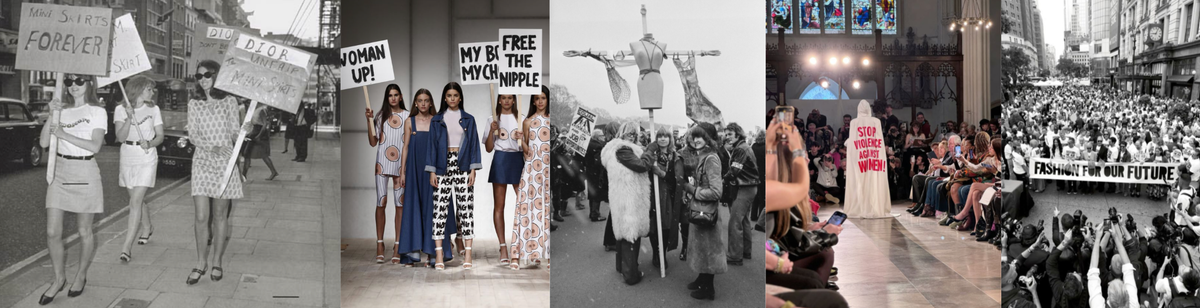
Fashion & Feminism
Fashion is political, that’s no secret. It’s not only about expressing an idea but also about driving real change. From human rights to ecology, every garment tells a story. One of the most striking transformations fashion has brought about is in the lives of women. Just by comparing a photograph of women in 1914 to one today, we can see a visible revolution, a clear emancipation told through clothing.
In this article, let’s dive into the fascinating dialogue between fashion and feminism, and explore how the two have shaped one another over time.
From Restriction to Revolution
Before the 1800s, women’s clothing symbolized confinement. Corsets with heavy boning and tight lacing dictated how women moved, breathed, and lived. Then came Amelia Bloomer, a pioneering feminist who dared to challenge the norm with her invention of bloomers, the first female trousers. They became a symbol of independence, adopted by women who wanted freedom both in life and in dress.
But not everyone welcomed this change. The public fixated on the scandal of women wearing pants instead of their message, and eventually, bloomers were abandoned. Still, they had already sewn the seeds of rebellion that would grow over the next century.
The Industrial Shift
During the Industrial Revolution, women entered factories, but by the 1840s, they were pushed back into domestic roles. Their wardrobes reflected that. Bulky, layered dresses that were anything but practical.
However, as the 1900s approached and women began working as secretaries and participating in sports, functionality became essential. Tailored suits for cycling and horseback riding emerged, gradually redefining the female silhouette.
Around the same time, the suffragettes gave colour to their cause. White for purity, purple for loyalty, and green for hope. These hues became powerful emblems of the movement, reclaiming femininity as strength rather than weakness.
The Rise of the “New Woman”
By the 1910s, trousers made their way into women’s wardrobes, thanks to designer Paul Poiret and his bold, harem-inspired styles. This era gave birth to the New Woman: independent, modern, and unapologetic.
In the 1920s, women cut their hair into sleek bobs, wore looser dresses that allowed movement, and embraced freedom. Coco Chanel further fuelled this shift with her minimalist, sporty aesthetic, a stark contrast to the restrictive fashions of the past.
When World War II brought women into the workforce, practicality dominated. But after 1945, as men returned home, society tried to re-domesticate women, and fashion followed suit. Tight-waisted dresses and shapewear made a comeback. Red lips and high heels, once symbols of glamour, became emblems of a forced femininity.
Liberation in Miniature
The 1960s changed everything. Mary Quant’s invention of the miniskirt coincided with the sexual revolution and the arrival of the contraceptive pill. For the first time, women could choose how much of themselves they wanted to reveal and that choice itself was liberation.
Fashion became more than fabric; it became a manifesto of freedom. Trousers, skirts, suits, women wore them all, depending on how they wished to express themselves.
Yves Saint Laurent Redefines Power
Few designers have shaped the narrative of female empowerment like Yves Saint Laurent. Born in 1936 in French Algeria, Saint Laurent revolutionized fashion by challenging the very codes that defined femininity.
In 1966, he introduced “Le Smoking”, the first women’s tuxedo. This bold creation didn’t just break sartorial rules, it redefined power itself. Women could now wear what had always been reserved for men, and in doing so, they claimed authority over their image.
Beyond the silhouette, Saint Laurent democratized fashion with his “Rive Gauche” ready-to-wear line, making high-end style accessible to a wider audience. He also blurred the boundaries between art and fashion with his Mondrian collection (1965) and his tributes to artists like Picasso, Matisse, and Van Gogh.
His vision turned fashion into a form of art, empowerment, and cultural expression. A legacy that still shapes modern design today.
Power Dressing & the 1980s
In the 1970s and 1980s, as women gained ground in the professional world, power dressing became the new armor. Structured blazers, padded shoulders, and tailored skirts symbolized authority and ambition.
However, feminism itself was divided. Some rejected traditionally feminine garments like pantyhose, while others saw reclaiming femininity as a powerful statement. Diane von Furstenberg’s wrap dress (1974) elegantly bridged this divide — feminine yet practical, empowering yet sensual.
The Modern Era
Today, feminist fashion embraces one central idea: choice. Whether through heels or sneakers, red lipstick or bare faces, women can decide what empowers them. There’s no longer a single “feminist look” because true freedom lies in self-expression.
This idea is still echoed in popular culture. From “The Handmaid’s Tale”, where the red robe symbolises female oppression, to modern designers using fashion as a medium for activism. The conversation between fashion and feminism is ongoing, evolving with every generation.
My thoughts
After exploring this journey, my own perspective on fashion has clarified. People often dismiss fashion as superficial, but it’s quite the opposite. What we wear is an expression of who we are and what we stand for. Clothing can provoke thought, challenge norms, and even inspire change.
Writing about this topic has been a way for me to pay homage to the women and men who fought before me. Women who dared to wear what felt right, not what was expected. I hope this post has made you see fashion in a new light and inspired you to wear your beliefs proudly.
See you in the next one.
XOXO
Eden
Resources : https://www.lofficielusa.com/fashion/womens-movement-feminist-fashion-history And https://madamparis.fr/en/blogs/infos/yves-saint-laurent-une-influence-durable-et-revolutionnaire-sur-la-mode?srsltid=AfmBOorODFa8cNw3dw-cwGKhld21MdTIU2K4IiOoF2zUTk5kSMHey1mf