How Movies Shaped our Fashion Fantasies

When Fashion Meets Film
Cinema and fashion have always shared a secret language. One of light, texture, movement, and emotion. From the very first silent films to today’s digital productions, clothes have played a crucial role in shaping how stories are told and how audiences connect to characters.
Fashion in film is not merely aesthetic; it’s symbolic. It gives form to identity, status, rebellion, and desire. Whether through the elegance of Grace Kelly, the eccentricity of David Bowie, or the avant-garde visions of today’s directors, fashion becomes an essential part of cinematic storytelling. Film gives fashion a voice, and fashion gives film a body.
Together, they mirror society’s evolution, capturing shifting ideals of beauty, gender, power, and freedom. Through this dialogue, cinema transforms fabric into emotion, and style into narrative.
Fashion as Storytelling
In cinema, a costume is never just clothing. It’s a psychological tool, a silent narrator. Costume designers are storytellers in their own right, using fabric, shape, and color to reveal who a character truly is, or who they wish to become.
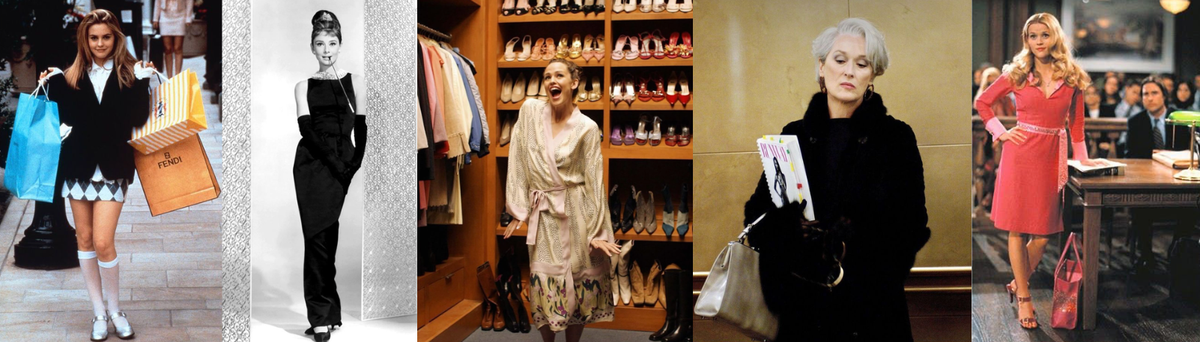
Think of Audrey Hepburn’s little black dress in Breakfast at Tiffany’s: simple, elegant, and liberating, a symbol of modern femininity. Or James Bond’s suits: precise, tailored, and indestructible, the perfect armor for control and seduction.
Costumes can whisper emotions or scream rebellion. In Black Swan, the transition from white to black tutus embodies the character’s descent into obsession. In Marie Antoinette, Sofia Coppola’s pastel rococo gowns illustrate both excess and fragility — beauty as a gilded cage.
Fashion in film constructs identity, challenges norms, and tells truths words cannot. It’s a visual poetry where fabric becomes fate.
Cinema as Cultural Influence
Cinema doesn’t just reflect fashion, it defines it. Many of the world’s most iconic styles were born on screen.
Audrey Hepburn’s timeless elegance inspired minimalist chic. James Dean’s red jacket and jeans in Rebel Without a Cause became the uniform of youth rebellion. John Travolta’s white disco suit in Saturday Night Fever captured an era of liberation and rhythm.
Every decade finds its muse on screen: from the romantic gowns of Hollywood’s Golden Age to the grunge aesthetics of the 1990s and the digital couture of today. Cinema acts as a bridge between fantasy and reality, making fashion accessible yet aspirational.
Beyond Western cinema, global industries like Bollywood and Korean cinema have redefined fashion’s role. Bollywood merges craftsmanship and emotion, transforming traditional garments like the sari into symbols of glamour and power. Korean dramas mix streetwear and modern tailoring, influencing global trends through subtle elegance. Cinema, in all its forms, exports not just stories but styles, creating a universal language of beauty.
New Age of Fashion
The streaming revolution changed everything. Platforms like Netflix, HBO, and Disney+ have turned costume design into a global conversation. Shows like Euphoria turned glitter and eyeliner into symbols of individuality and youth expression. Emily in Paris revived Parisian chic with a playful, colorful twist. And Squid Game transformed utilitarian tracksuits and pink jumpsuits into global pop culture icons.
Unlike traditional films, series allow costumes to evolve alongside characters. Villanelle in Killing Eve embodies this dynamic perfectly. Her unpredictable wardrobe mirrors her psyche: chaotic, flamboyant, magnetic. The audience doesn’t just observe fashion anymore; they interact with it, replicate it, and reinterpret it through social media.
Fashion has become participatory, a dialogue between creator and viewer. The screen no longer dictates trends, it inspires individuality.
Fantasy, Art, and the Rise of the Fashion Film
Beyond narrative cinema, a new hybrid genre has emerged: the fashion film. These short, conceptual films blend haute couture and cinematic artistry. Designers like Prada, Gucci, and Alexander McQueen collaborate with visionary directors to create immersive universes where fabric meets fantasy.
Prada’s Fallen Shadows explores surreal elegance, while McQueen’s holographic projection of Kate Moss remains one of fashion’s most haunting moments. Ethereal, poetic and unforgettable. Mary Katrantzou, known for her digital prints, uses film to transform clothes into living canvases of color and movement.
These creations blur the lines between advertisement and art. They are not simply promotional tools but rather expressions of imagination. A continuation of cinema’s tradition of visual storytelling. Fashion films reflect how technology and creativity merge to express something timeless: emotion through form.
The Art of Scenography
What makes the fusion of cinema and fashion truly magical is scenography. The way light, architecture, and movement frame clothing as a living story. A film set or a runway can both become stages for transformation.
Think of Baz Luhrmann’s The Great Gatsby, where shimmering dresses and golden light recreate the roaring twenties in all their intoxication. Or the cinematic fashion shows of brands like Chanel or Dior, where storytelling meets architecture, from enchanted forests to celestial dreamscapes.
In Matthieu Blazy’s latest Chanel show, for instance, the scenography was breathtaking. A glowing sun hovered above mirrored floors, creating an illusion of infinite space. Every garment seemed to move in dialogue with light, as if the universe itself was part of the choreography. It was more than a show, it was cinema without a screen.
My Thoughts
Learning about the deep connection between fashion and cinema has completely changed the way I perceive both worlds. I’ve always loved style, but I had never realized how powerfully clothes could tell stories, embody emotions, and shape identities. Watching the dialogue between light, texture, and movement made me understand that fashion isn’t only about aesthetics, t’s about meaning.
I was amazed by the scenography and the artistry behind it all: the glowing lights, the mirror reflections, the choreography of the fabrics. The pieces themselves were breathtaking. Both modern and timeless, balancing innovation and tradition. It reminded me that fashion, when seen through the lens of cinema, becomes something larger than life.
Every dress, every fabric, every cinematic frame carries a story. one that speaks of who we are, what we dream of, and how we express it. Fashion in cinema isn’t just about beauty. It’s about the poetry of movement, the art of transformation, and the eternal dialogue between image and emotion.
See you in the next one,
Xoxo
Eden
Resources : the-role-of-film-and-media-in-translating-culture-into-fashion - fashion-influence - the-relationship-between-fashion-film-and-animationfantasy