Miuccia Prada

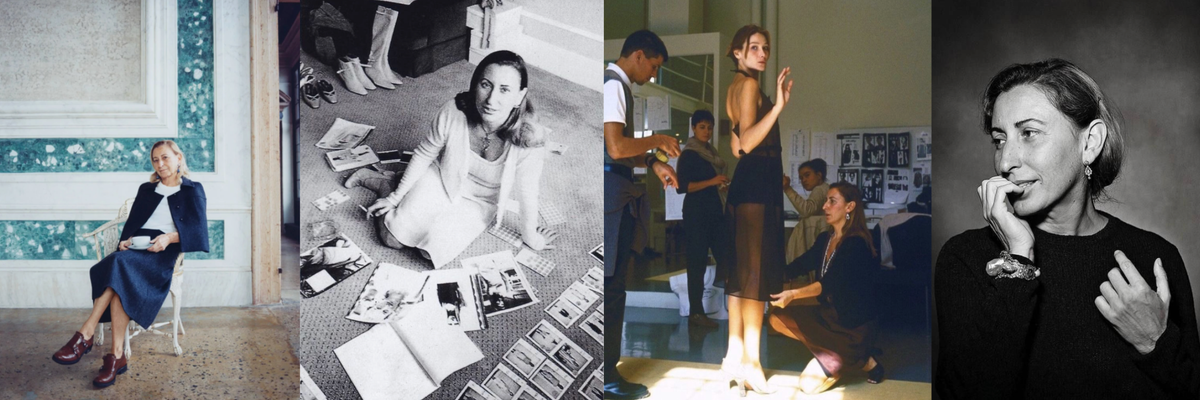
Miuccia Prada (born Maria Bianchi on May 10, 1948, in Milan) is one of the most influential figures in contemporary fashion. Billionaire designer, businesswoman, political thinker, and art patron, she transformed a modest family leather goods company into a global luxury powerhouse.
She is the youngest granddaughter of Mario Prada, who founded Prada in 1913 under the name Fratelli Prada. Originally, the brand specialized in fine leather goods and imported luggage.
Adopted by her aunt, she took the name Miuccia Prada in the 1980s. Today, she serves as Executive Director of the Prada Group, Co-Creative Director of Prada alongside Raf Simons, and Creative Director of Miu Miu.
Education & Political Formation
Unlike many designers, Miuccia Prada did not initially pursue fashion. She earned a PhD in political science from the University of Milan and was deeply involved in the Italian Communist Party and feminist movements during the 1970s.
At the same time, she trained as a mime artist at the Piccolo Teatro in Milan, performing for five years. This background profoundly influenced her understanding of clothing as a silent language a way to express ideas without words.
Her political and intellectual formation would later shape her fashion philosophy: clothing not just as decoration, but as commentary.
Taking Over Prada & The Nylon Revolution
In 1978, she took over the family business and met her future husband and business partner, Patrizio Bertelli. Together, they radically reimagined the brand.
In 1979–1985, she introduced black nylon handbags made from industrial Pocono fabric. At the time, using synthetic nylon in luxury was almost provocative. Yet the minimalist backpacks and bags became global icons.
This was the birth of what critics later called “intellectual luxury.”
Ready-to-Wear & The Birth of Miu Miu
- 1988: First Prada womenswear collection, described as “uniforms for the slightly disenfranchised.”
- 1993: Launch of menswear.
- 1993: Creation of Miu Miu, named after her childhood nickname.
Miu Miu was conceived as Prada’s rebellious younger sister, playful, ironic, more instinctive. By 2025, Miu Miu recorded a 41% increase in retail sales in the first nine months of the year, becoming a dominant force within the group.
"Ugly Chic”
Miuccia Prada never aimed to create flattering, obvious beauty. She explored what she sometimes described as “ugly chic”, challenging traditional standards of attractiveness.
Her collections mix:
- Minimalism and ornamentation
- Bourgeois codes and subversion
- Pop references and intellectual restraint
She once said:
“I never try on clothes. When I make fashion, I dress my ideas.”
For her, garments are intellectual statements before they are products.
Expansion & Strategic Growth
Under her and Bertelli’s leadership, the Prada Group expanded significantly. It includes:
- Prada
- Miu Miu
- Church's
- Car Shoe
- Versace (acquired in 2025 for €1.25 billion)
After the Versace acquisition, her son Lorenzo Bertelli was appointed Executive Chairman of Versace, formalizing succession plans.
In January 2023, Prada stepped down as Co-CEO to focus on creative strategy, remaining on the board.
Architecture & Retail Innovation
Prada was among the first designers to collaborate with Pritzker Prize-winning architects like Rem Koolhaas and Herzog & de Meuron to create “Epicenter” flagship stores in New York (2001), Tokyo (2003), and Los Angeles (2004).
These spaces blended architecture, technology, and fashion, redefining retail as cultural experience.
Art Patronage & Fondazione Prada
In 1993, she co-founded Fondazione Prada, now one of the most respected contemporary art institutions.
She has collaborated with artists like Cindy Sherman and Francesco Vezzoli and was honored in 2012 at the Metropolitan Museum of Art exhibition “Impossible Conversations” alongside Elsa Schiaparelli.
Her work proves fashion and contemporary art can coexist, even if she insists:
“Art is for expressing ideas. My job is to sell.”
Controversies & Limits
No global empire grows without complexity.
In 2014, Miuccia Prada and Patrizio Bertelli were investigated in a tax avoidance probe in Italy. By 2016, they paid over €400 million to settle their tax position.
This episode revealed the tension between global luxury expansion and ethical financial practices, reminding us that even visionary leaders operate within controversial corporate realities.
Additionally, Prada’s intellectual aesthetic has sometimes been criticized as elitist or inaccessible. Her work demands cultural literacy, which can create distance between brand and consumer.
My Thought
What fascinates me most about Miuccia Prada is not just her success, but her contradiction.
She is a former communist who became a billionaire. A mime artist who built a global empire. An intellectual who sells luxury.
She proves that fashion can be political without being literal. That clothing can question society instead of simply decorating it.
For me, she represents a different kind of creative leadership, one that blends strategy, culture, art, and business intelligence. She didn’t just design clothes. She designed a way of thinking about fashion.
And that is far more powerful.
References:
- Wikipedia:Miuccia_Prada
- Numéro: miuccia-prada
- Elle: Miuccia-Prada
- Business of Fashion: miuccia-prada
Images: