Miumiu Show
A Factory-Canteen in Couture
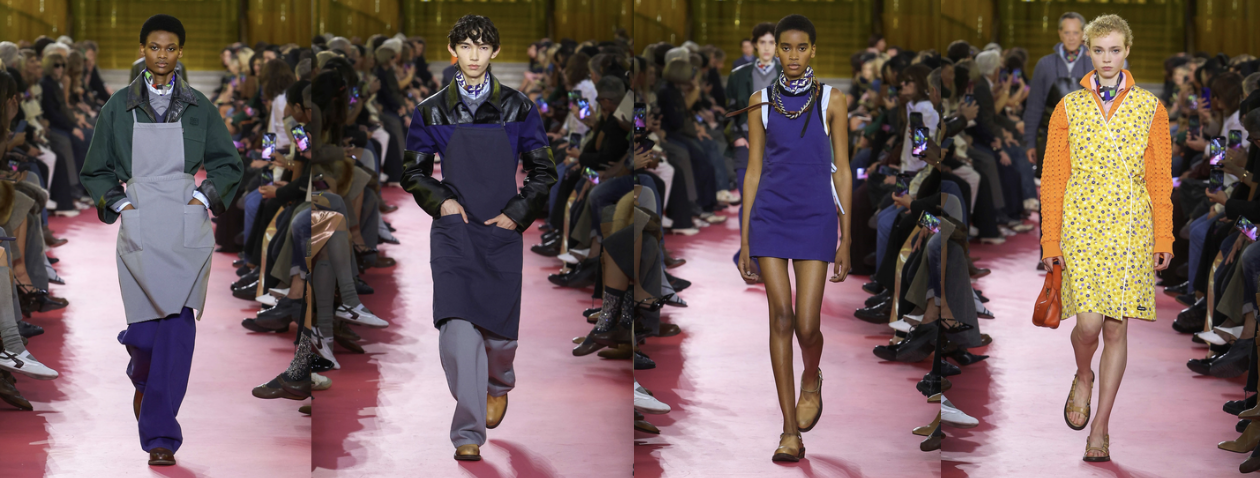
For the Spring/Summer 2026 collection titled “At Work”, designer Miuccia Prada transformed the runway into a symbolic workspace. The audience sat on melamine-topped tables, the floor was a rubberised hue, the air perfumed of cleaning-fluid memory.
The first model to appear was actor Sandra Hüller in a heavy-duty utilitarian apron, hands in pockets—a striking image that signalled the show’s commitment to work, labour, and the often unseen realms of women’s life.
Prada explained “In fashion we always talk about glamour or rich people, but we have to recognise also that life is very different… To me the apron contains the real difficult life of women in history, from factories to home.”
Thus the set, the mood, the staging, all collaborated in forcing a shift in perception, high fashion could dwell not only in spectacle but in the daily, the functional and the hidden.
The Apron Reimagined
Aprons appeared throughout the show in diverse materials and interpretations. Canvas and cotton-drill echoed factory work. Leather aprons with D-ring hardware referenced trade-tools. Lace, crochet, and jewels elevated the domestic to the couture.
For example: what begins as a utilitarian leather apron transforms into a shimmering statement piece worthy of the red-carpet. The same garment oscillates between function and luxury.
By repurposing the apron, Prada taps into both memory and metaphor: the apron as protector, as barrier, as symbol of care, as tool of labour. In her words:
“Across all [work], the apron as a symbol … expresses the effort and challenges of women.”
What’s powerful is the layering of that meaning: the apron has once been invisible, humble, overlooked. Here it becomes visible, elevated, and impossible to ignore.
Labour, Gender and the Invisible Workforce
Beneath the aesthetics lies a commentary on labour, especially women’s labour, visible and invisible. Domestic workers, factory operatives, mothers working behind the scenes, they are the unseen scaffolding of modern society, and Prada brings them into view.
For example, the show nods to homemakers’ work, the late-shift cleaners, the craftswomen whose names rarely appear in credits. Aprons worn over dresses, aprons worn as dresses, workwear boots paired with couture accessories. The intersection of class, gender and work is firmly on display.
Yet this also prompts questions. Can high fashion truly honour labour when it remains inaccessible to many? The show makes us ask, if the garment references hard work, but only someone with resources can own it, what does that say? The gesture is meaningful, but the commercial reality has its limits.
Empowerment & Appropriation
Positive side:
The collection subverts the “glamour only” narrative of fashion by elevating workwear as meaningful. It grants dignity to the overlooked, stating that ordinary effort is worthy of display.
Limitations:
Some observers point out that the very pricing and exclusivity of high fashion risk undermining the gesture. A pristinely tailored apron dress is very different from the utilitarian smock worn by domestic staff. The question remains: does the runway amplify or aestheticise invisible labour? The transformation of the apron into luxury (lace, jewels) tempts us into fetishising labour rather than honouring it.
In short, when you raise the symbol of labour to couture status, you spotlight the work. But also flag the class divide. This tension is not a failure, but part of what makes the collection provocative.
Visuals & Symbolism
The set design, tables and fluorescent lights, echoes a cafeteria; the styling plays with uniform codes. Barn jackets, heavy boots, tool-belts mixed with frills. Uniform becomes runway. The apron becomes visual shorthand for labour, identity, gender, class.
Yet Prada tweaks the codes. Aprons worn over bikini tops, or left open at the back; leather aprons layered with lace, there’s an undercurrent of disruption. Domesticity isn’t sanitised. It’s layered, undone, visible.
Symbolically, the show implicates us: the garment is not just clothes. It is history, identity and work. By forcing the apron into high fashion, Prada invites us to see what we usually don’t.
When Domesticity Meets Digital Fantasy
In the era of “tradwife” aesthetics on social media, where domesticity becomes curated and romanticised, Miu Miu’s apron collection offers a riposte. It doesn’t indulge in nostalgia for a pastel-pinned homemaker; it reframes domesticity as labour, as endurance, as visible.
This is timely. In a moment saturated with images of perfection, the show says: labour matters. Care matters. Work that goes unseen matters. When fashion uses the apron as testament rather than ornament, the message shifts.
My Thought
For me, this collection resonates deeply. There is something radical about wearing the apron. The very sign of service, care and labour on the runway, in full view. It forces us to ask: whose work gets adorned and whose remains unseen?
I admire how Prada celebrates the mundane and elevates it without flattening it into fetish or fantasy. At the same time, I feel the tension of luxury's reach: if you cannot buy the clothes, can you still access the value? The collection leaves me with respect for the stories behind the seams and a reminder that fashion can mirror society just as much as it dresses it.
The apron becomes more than garment. It becomes a statement: I labour, I care, I matter.
See you in the next one,
Xoxo
Eden
Resources
10 Magazine: Miu Miu: Ready-to-Wear SS26 – https://10magazine.com/miu-miu-ready-to-wear-ss26/
Elle: Miu Miu Spring/Summer 2026 – https://www.elle.com.au/fashion/runway/miu-miu-spring-summer-2026/ELLE
Grazia: Miu Miu Turns the Apron into a Feminist Power Symbol – https://graziamagazine.com/us/articles/miu-miu-aprons-feminist-power-symbol-paris-fashion-week/
Hypebae: Miu Miu SS26 – Women at Work – https://hypebae.com/2025/10/miu-miu-ss26-paris-fashion-week-kylie-jenner-towa-bird-cortisa-star
Photos
Photo 1: https://10magazine.com/miu-miu-ready-to-wear-ss26/ (Runway look image)
Photo 2: https://vmagazine.com/article/miu-mius-ss26-collection-celebrates-womens-workwear/ (Close-up of apron look)
Photo 3: https://graziamagazine.com/us/articles/miu-miu-aprons-feminist-power-symbol-paris-fashion-week/(Model in industrial apron look)