The Evolution of Fashion Shows
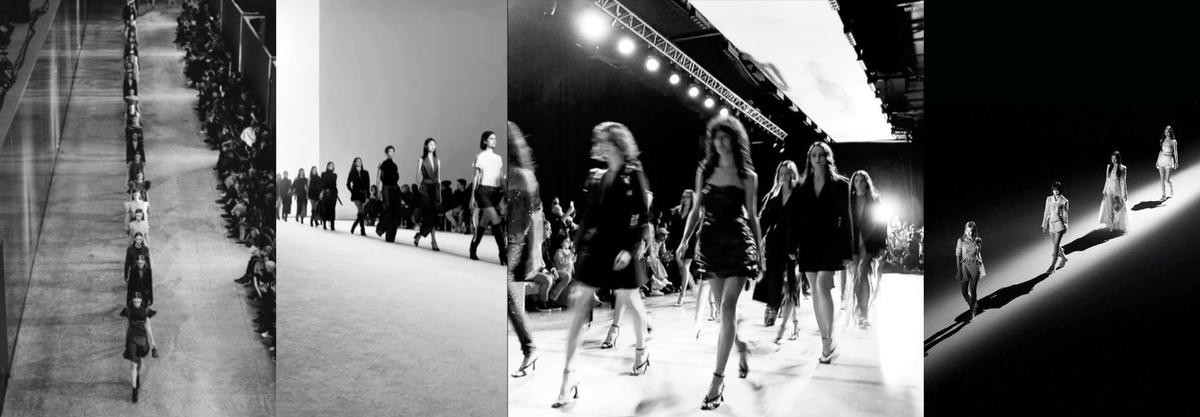
A fashion show is an event where designers present their upcoming collections of clothing and accessories, usually during fashion week. These shows debut every season, primarily Spring/Summer and Fall/Winter, and serve as both artistic statements and marketing tools.
The four major fashion capitals, often called the “Big Four,” are:
- New York City
- London
- Milan
- Paris
Additionally, Berlin Fashion Week has gained global importance.
In a typical runway show, models walk along a catwalk wearing the designer’s collection. Lighting, music, and staging enhance the atmosphere. The order of the looks is carefully planned to tell a visual story. Each outfit contributes to the overall message of the collection.
Fashion shows can also take the form of installations, theatrical performances, or digital productions using holograms and video projections.
The Origins 19th – Early 20th
The modern fashion show dates back to the 1860s. English designer Charles Frederick Worth revolutionized fashion presentation by using live models instead of mannequins in Paris.
By the early 1900s, “fashion parades” spread to London and New York. The first American fashion show likely took place in 1903 at the Ehrich Brothers department store in New York. Soon, large department stores such as Wanamaker’s organized similar events.
These shows were intimate and private, often reserved for buyers and journalists. Photography was frequently banned to prevent copying.
After World War II, fashion houses began seeking publicity. In 1947, Christian Dior presented his revolutionary “New Look,” marking a turning point in fashion history and signaling a return to femininity and luxury after wartime austerity.
The Rise of Fashion Weeks and Global Expansion
In 1943, publicist Eleanor Lambert created “Press Week” in New York, which later became New York Fashion Week. This established the idea of a fashion calendar.
Italy entered the scene in the 1950s, with shows in Florence before moving to Milan under the Camera Nazionale della Moda Italiana.
By the 1970s, ready-to-wear collections overtook haute couture. Paris officially coordinated shows under the Chambre Syndicale du Prêt-à-Porter, solidifying the structure of Fashion Week as we know it today.
The Spectacle Era, 1980s–2000s
From the 1980s onward, fashion shows became theatrical productions.
- Yves Saint Laurent staged a stadium show in 1998 before the World Cup Final.
- Alexander McQueen transformed runways into wind tunnels, chess boards, and dramatic performance spaces.
- Karl Lagerfeld recreated supermarkets, airports, and even staged shows inspired by the Great Wall of China.
Runways evolved from simple catwalks into immersive art installations. Budgets increased dramatically. Branding became central.
Digital Transformation in the 21st Century
Technology revolutionized fashion shows:
- In 1998, Helmut Lang presented his collection online.
- In 2010, Alexander McQueen livestreamed his show.
- Today, most shows are streamed globally and shared instantly via Instagram.
Designers such as Ralph Lauren incorporated digital projections in Central Park, and Tom Ford collaborated with Lady Gaga for a video-based presentation.
The “see now, buy now” model emerged, allowing customers to purchase items immediately after the show. Fashion became more accessible, but also more commercial.
Models and the Modeling Industry
With the rise of runway shows came professional modeling agencies. Previously, fashion houses used in-house models to ensure perfect garment fit.
Today, runway modeling is a global profession. Securing an “exclusive” with a major brand can launch a model’s career.
Inclusivity
Historically, fashion shows featured mostly young, thin, tall, Eurocentric models.
Over the past decade, representation has improved:
- Nonwhite model representation increased significantly between 2015 and 2023.
- Plus-size representation has grown but remains limited.
However, challenges persist:
- Sample sizes are often produced only in very small sizes.
- Producing inclusive sample collections increases costs.
- Retailers frequently buy only smaller sizes even when inclusive designs are shown.
Some designers, including Christian Siriano, Chromat, and Collina Strada, actively promote diverse casting. Brands like Savage X Fenty and Tommy Hilfiger Adaptive also prioritize representation across gender identities, body types, and abilities.
Despite progress, inclusivity remains inconsistent and sometimes performative.
The Front Row and Status Culture
The “FROW” (front row) has become symbolic of power in fashion.
Editors, buyers, celebrities, influencers, and VIP clients compete for prime seating. Status hierarchy is visible through seating placement.
This reflects both the glamour and exclusivity of fashion, but also its social and economic inequalities.
Limits and Criticism
While fashion shows are artistic and inspiring, they face criticism:
- Excessive costs (some shows costing millions for less than 15 minutes).
- Environmental impact from international travel and elaborate sets.
- Commercial pressure, shifting focus from creativity to virality.
- Exclusivity, reinforcing social hierarchies.
The rise of digital formats during the pandemic accelerated questions: Do we still need everyone in the same place at the same time? Is fashion week still necessary in its traditional format?
The industry is still negotiating these questions.
Conclusion
From Charles Frederick Worth’s private salon presentations to today’s livestreamed global spectacles, fashion shows have transformed dramatically.
They are no longer just about clothing, they are about storytelling, branding, technology, performance, and cultural influence.
Yet despite their evolution, the core remains unchanged: a designer presenting a vision of the future through garments worn by living bodies.
My Thought
Personally, I find fashion shows fascinating because they are a mix between art, marketing, and cultural reflection. What started as intimate presentations for wealthy clients has become a global spectacle watched by millions.
However, I also think the industry must confront its limits, especially regarding sustainability and inclusivity. While shows are more accessible digitally, true representation still has progress to make.
Fashion shows are powerful because they shape how we see beauty, identity, and status. That power comes with responsibility.
For me, fashion shows are not just entertainment, they are a mirror of society.
See you in the next one,
Eden
Resources :
- Wikipedia: Fashion_show
- CCN: fashion-show-origins
- Glam observer: the-evolution-of-fashion-shows
- Jobwork: fashion-show
- The guardian: the-view-from-the-front-row-a-history-of-the-fashion-show-photo-essay
Photos :