Vivienne Westwood ( The Designer )

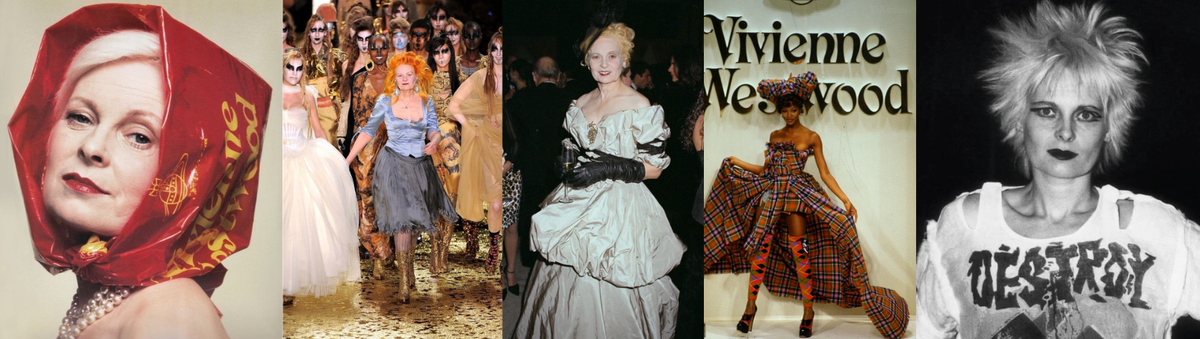
The Origins of a Rebel
Vivienne Isabel Swire was born on April 8, 1941, in Tintwistle, Derbyshire, into a modest family. Her father a shoemaker and her mother a cotton-factory worker. Growing up in post-war Britain, she developed a sense of independence early on. At seventeen, she left her countryside home to study fashion at Harrow School of Art in London, now Westminster University.
Though she abandoned fashion studies after a single term and became a primary school teacher, her creative spirit was impossible to suppress. By the early 1960s, she was already experimenting with unconventional clothing and frequenting London’s vibrant nightlife.
In 1962, she married Derek Westwood, a nightclub manager, with whom she had her first son, Benjamin. But in 1965, everything changed. She met Malcolm McLaren, a young artist and provocateur who would soon become the manager of the Sex Pistols. Their partnership would transform her life and the entire fashion world.
Punk as a Political Weapon
In 1971, Vivienne and Malcolm opened a small shop at 430 King’s Road in London. The boutique, initially called Let It Rock, sold 1950s-style rock’n’roll clothes, but quickly evolved into something radical. The shop changed names and styles. Too Fast to Live, Too Young to Die, then SEX, Seditionaries, and finally World’s End. Each new phase reflecting a new rebellion.
Their creations were scandalous and magnetic: ripped t-shirts with anarchist slogans, leather bondage trousers, and underwear worn as outerwear. Through fashion, Westwood expressed rage, irony, and resistance.
She dressed the New York Dolls and Sex Pistols, turning them into walking manifestos. Her designs became a visual protest, against consumerism, class systems, and authority.
As she later said, “I wasn’t trying to make fashion. I was trying to make people think.”
By the late 1970s, Vivienne Westwood had not only dressed a generation, she had built a movement. Punk became fashion, and fashion became rebellion.
Reinvention and Creative Freedom
After separating from McLaren in the early 1980s, Westwood took her talent beyond punk. Her 1981 Pirates collection, presented first in London, then in Paris, marked the beginning of her international success. The show mixed historical references, unisex silhouettes, and theatrical energy. Models walked with gold teeth, henna hair, and Walkmans on their belts. An audacious mix of fantasy and street culture.
Each subsequent collection explored a new world: Witches (1983) revisited the mystique of the sorceress, Savage (1982) drew on tribal traditions, and Mini-Crini (1985) reimagined Victorian corsets and crinolines through a punk lens.
Her designs blended the past and the future. Baroque, historical, yet rebellious.
In 1989, Women’s Wear Daily named her among the world’s top six designers. She became the enfant terrible of British fashion, alongside Jean Paul Gaultier. Her audacity, theatricality, and constant reinvention made her a cultural icon.
Love, Legacy, and Environmental Activism
In 1988, Vivienne met Andreas Kronthaler, a 22-year-old student from the Vienna School of Applied Arts, where she was teaching. Despite their 25-year age gap, they became inseparable, both in life and in creation. They married in 1993, and together, they transformed her brand into a platform for artistic experimentation and political activism.
From the 1990s onward, Westwood turned her rebellious energy toward environmental causes. She banned fur from her collections, collaborated with Greenpeace on the Save the Arctic campaign, and urged people to “Buy less, choose well, make it last.”
Her activism didn’t stop at fashion. She protested climate injustice, government corruption, and defended WikiLeaks founder Julian Assange, famously staging protests in his support.
Her message remained constant: style is political, and fashion can be a tool for revolution.
The Eternal Punk Spirit
Throughout her life, Vivienne Westwood embodied contradiction — elegance and rebellion, tradition and provocation. She could design a historical corset inspired by François Boucher and, in the same season, walk out of Buckingham Palace without underwear to mock royal convention.
Her influence extended far beyond clothing. She shaped how fashion interacts with society — blending art, politics, and consciousness. Crowned British Designer of the Year three times, knighted by Queen Elizabeth II in 1992, and made a Dame in 2006, she redefined what it means to be a designer.
When she passed away peacefully on December 29, 2022, at age 81, her husband Andreas Kronthaler wrote:
“We worked until the end, and she left me so many things to continue. Thank you, my love.”
Vivienne Westwood wasn’t just a designer. She was a revolution — and her legacy will forever remind us that fashion can change the world.
My Thoughts — The Power of Rebellion and Art
Learning about Vivienne Westwood truly opened my eyes to what fashion can represent beyond aesthetics. I was amazed by the scenography of her shows, where every detail, from the lighting to the sound, felt like an act of rebellion turned into poetry. Her pieces struck me as more than garments; they were statements of freedom, courage, and resistance. What fascinates me most is how she transformed anger and nonconformity into beauty. She used clothing as a language to challenge authority, question consumerism, and advocate for the planet long before sustainability became a trend. Seeing her blend elegance with provocation made me realize that fashion can be both political and deeply human. Vivienne Westwood didn’t just create clothes, she created meaning.
See you in the next one,
Xoxo
Eden
Resources : Vivienne_Westwood - vivienne-westwood-histoire - les-immoderes-icone-1-le-portrait-de-la-styliste-britannique-vivienne-westwood - la-styliste-britannique-vivienne-westwood-icone-du-punk-est-morte_6156032_3382.html