Yuima Nakazato Haute Couture SS26

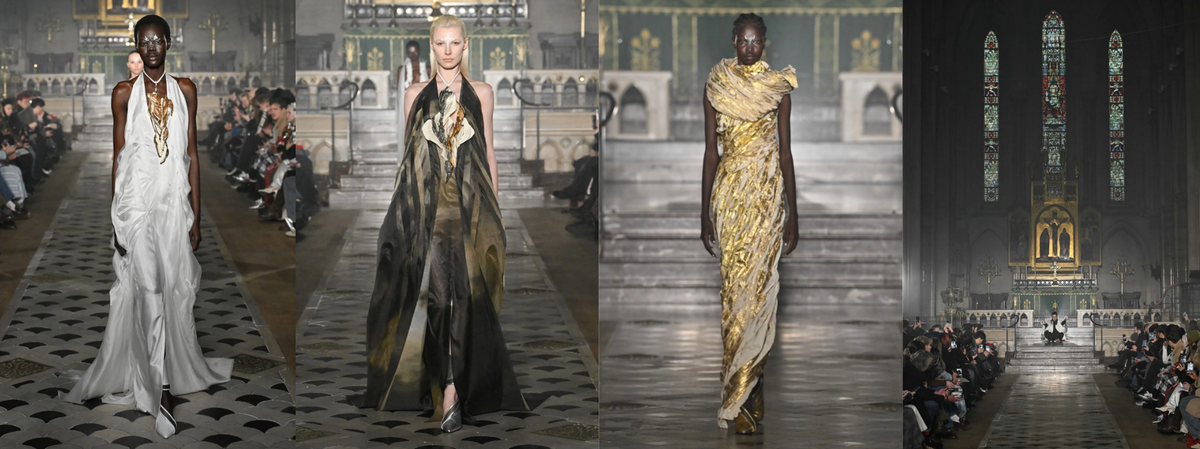
For Spring/Summer 2026, Japanese couturier Yuima Nakazato presented a haute couture collection in Paris that redefined what fashion can be. Titled Silent, the collection moved away from spectacle and trends, offering instead a meditation on nature, time, material, and human existence. Presented at the American Cathedral in Paris, the show felt less like a runway event and more like a ritual, an immersive experience rooted in geology, craft, and philosophy.
Yakushima and the Weight of Deep Time
The conceptual foundation of the collection originated on Yakushima Island, a remote region in Japan’s Kagoshima Prefecture, known for its ancient Yakusugi cedar trees, some thousands of years old.
Nakazato described walking through a landscape untouched by modern construction, touching river-smoothed stones and tree rings under moonlight. Confronted with deep geological time, he reflected on humanity’s desire to not just imitate nature, but merge with it.
“Humans have always perceived a primal beauty in nature, desiring not only to wear it but to become a part of it.”
This experience shaped the emotional core of the collection: fashion as a dialogue with nature rather than a domination of it.
1,500 Hours of Ceramic Creation
One of the most remarkable aspects of the collection was its material commitment. Over six months, Nakazato personally spent more than 1,500 hours crafting thousands of ceramic elements by hand.
As he molded clay, he described his hands gradually learning the movement of the earth, producing organic, streamlined forms reminiscent of erosion, fossils, bark, fungus, and river stones.
The garments appeared less constructed than grown, embodying a tactile relationship between body, earth, and time.
Garments as Living Landscapes
The collection’s silhouettes felt timeless rather than trendy, existing outside conventional fashion eras.
Key visual elements included:
- Ceramic fragments forming sculptural exoskeletons
- White earthenware beads glazed with gold and silver accents
- Dresses evoking tree leaves, stone textures, bark, and sediment layers
- Knit webbing and metallic chains anchoring ceramic structures
- Layered fabrics referencing tree-ring growth patterns
- Crinkled metallic fabrics recalling weathered bark
- Silver and gold ankle boots developed using Epson’s fabric-recycling and urushi lacquer techniques
Rather than expressing luxury through excess, Nakazato emphasized patience, restraint, and devotion.
The Earth as Orchestra
Perhaps the most radical artistic choice was the absence of music.
Instead, the soundtrack consisted of the soft clinking of ceramic pieces as the models moved. Nakazato himself sat cross-legged beneath the cathedral altar, tapping porcelain rings together to contribute to the atonal rhythm.
He described the effect as:
“The sound of the earth itself, awakening memories from when soil first came into being.”
In a world saturated with digital noise, the show demanded slowness, listening, and attention.
Technology, Tradition, and Innovation
Nakazato continues to position himself at the crossroads of:
- Artisanship
- Philosophy
- Material science
- Sustainable technology
Through his partnership with Epson, he developed:
- Fray-free fabric cutting using transparent ink
- Recycled textile boots coated in urushi lacquer
- Sharper silk silhouettes with minimal waste
This fusion demonstrates that innovation can serve both beauty and sustainability.
Cultural and Intellectual Impact
By stripping away spectacle, Nakazato delivered one of Paris Couture Week’s most intellectually resonant moments.
Rather than producing garments meant for trends or headlines, the collection offered:
- A philosophical reflection on time
- A reconnection with nature
- A vision of couture as memory, ritual, and ecosystem
He positioned himself not only as a couturier, but as one of fashion’s most rigorous contemporary thinkers.
Where the Collection May Divide Audiences
While widely praised, the project raises valid limitations:
- Wearability concerns: Ceramic garments are more sculptural than practical.
- Extreme production time: Spending 1,500 hours makes scalability nearly impossible.
- Exclusivity: Haute couture remains inaccessible to most people.
- Concept over comfort: The artistic message may overshadow usability.
- Sustainability paradox: Though conceptually eco-inspired, ceramic production and couture labor still carry environmental and economic costs.
These critiques highlight the tension between art, ethics, and real-world application.
Couture as Stillness and Memory
Yuima Nakazato’s Silent does not chase fashion cycles. Instead, it offers a rare moment of stillness, reminding us that couture can reconnect us with forces older than fashion itself, earth, time, erosion, and memory.
It proposes a future where clothing becomes philosophy, landscape, and ritual, not just product.
My Thought
What fascinates me most about Yuima Nakazato’s work is how he transforms fashion into a form of meditation rather than consumption. This collection proves that couture can carry emotional, cultural, and ecological meaning, not just visual beauty. At the same time, it raises important questions about accessibility and sustainability. For me, Silent represents what fashion can become when it stops trying to impress and starts trying to connect.
See you in the next one,
Eden
Resources:
- designart magazin: yuima-nakazato-haute-couture-ss26.html
- Yuima Nakazato: couture_ss2026.html
- WWD: review
Photos: