Yves Saint Laurent (The Creator)

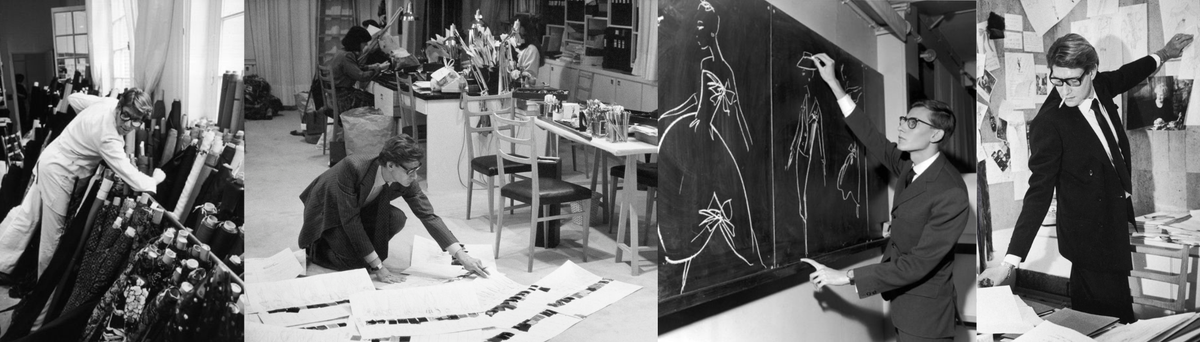
YVES SAINT LAURENT – The Visionary
If we want to learn about fashion, it’s essential to talk about the visionary personalities who helped shape its history. Today, let’s explore the world of the legendary Yves Saint Laurent, whom I mentioned in my previous post about feminism in fashion. He was not only a brilliant creator but also a revolutionary thinker who profoundly influenced women’s emancipation through style.
Biography
Yves Mathieu-Saint-Laurent, better known as Yves Saint Laurent (YSL), was born on August 1, 1936, in Oran, Algeria, and passed away on June 1, 2008, in Paris. From an early age, he displayed a remarkable talent for drawing and design. After moving to Paris, he joined Christian Dior’s atelier, where his exceptional eye for structure and silhouette quickly made him Dior’s protégé. When Dior passed away unexpectedly, the young Saint Laurent, just 21 years old, was chosen to take over the house, an extraordinary recognition of his genius.
His first major success came with the “Trapèze” collection, which liberated women’s bodies from the rigid structures of post-war fashion. A few years later, in 1962, he launched his own house with Pierre Bergé, marking the beginning of one of the most iconic fashion legacies of the 20th century.
Over the years, he introduced pieces that would forever redefine women’s wardrobes: the Mondrian dress, the Pop Art collection, the Safari jacket, sheer blouses, thigh-high boots, and, of course, the revolutionary tuxedo suit for women – “Le Smoking.”
The Spirit of Yves Saint Laurent
The genius of Yves Saint Laurent lies in his deep connection to real life and the street. Unlike many couturiers of his time who designed for an elite, Saint Laurent wanted to dress all women, to bring elegance, confidence, and independence into everyday life.
With him, fashion became a language of freedom and individuality. He blurred the lines between masculine and feminine, between luxury and practicality.
Yves Saint Laurent was fascinated by the idea of transformation. How a woman could reinvent herself simply by what she wore.
His designs were both bold and delicate: subtle plays of transparency, asymmetrical and structured cuts, and a unique mastery of proportion that celebrated the female form without confining it. He redefined sensuality as something powerful and intelligent, not submissive.
Saint Laurent also initiated the fusion of genres, making men’s wardrobes a playground for women. Blazers, trousers, and shirts became symbols of empowerment rather than rebellion.
Iconic Creations
The creations that defined the Saint Laurent DNA remain timeless symbols of innovation and freedom.
- In the early 1960s, he democratised the tuxedo, turning it into a symbol of female strength and confidence. “Le Smoking” became a weapon of empowerment. Structured, sleek, and endlessly modern.
- In 1965, the Mondrian dress paid tribute to modern art, transforming abstract painting into wearable geometry.
- In 1967, the Safari jacket (La Saharienne) combined functionality with glamour, capturing the spirit of adventure and sensuality.
These designs weren’t just clothes; they were statements about art, travel, gender, and identity. They embodied his love of culture, his curiosity, and his refusal to separate fashion from life.
Today, though the house became simply “Saint Laurent” in 2012, its essence remains. Each season, the brand continues to light up Fashion Week with rock-inspired, sensual, and sculptural creations that echo Yves’s original vision.
Sharp silhouettes, bold textures, and fiery character, he Saint Laurent runway is still a space where power meets elegance, and where women are celebrated in all their complexity.
Impact and Legacy
Yves Saint Laurent wasn’t just a couturier, he was a cultural architect. His collections reflected social change, feminism, and the fusion of art and fashion. He was among the first to cast models of color, to honor non-European beauty’ and to make ready-to-wear (“Rive Gauche”) a prestigious, democratic concept.
His influence extended beyond the atelier: he made fashion accessible, bridged art and clothing, and gave women the freedom to dress for themselves.
Even decades after his passing, his spirit still breathes through modern fashion. Designers across the world reinterpret his codes — the tuxedo, the sharp blazer, the artistic prints — proving that his revolution is far from over.
My Thoughts
Personally, Yves Saint Laurent has always fascinated me. Not just as a designer, but as a visionary who understood that fashion could be a tool for expression and empowerment. What strikes me most is his ability to combine aesthetic intelligence with social awareness.
When I look at his work, I don’t just see clothes; I see a dialogue between identity and culture. His garments allowed women to be whoever they wanted. Powerful, mysterious, romantic, or daring, all without needing to conform.
“Le Smoking” wasn’t just a suit. It was a symbolic revolution. It gave women permission to occupy space confidently, to challenge expectations, and to define beauty on their own terms.
I also admire his intellectual approach to design. His deep appreciation for art, his sensitivity to color, his architectural sense of silhouette. Each piece he created seemed to carry a story, a vision of the world translated into fabric.
Writing this newsletter made me reflect on how relevant his legacy remains. Yves Saint Laurent didn’t just design garments, he designed possibilities. His work reminds us that fashion isn’t superficial. It’s a reflection of society, emotion, and evolution.
Even now, every time a woman puts on a sharply tailored blazer or a flowing transparent blouse, she carries a little piece of that Saint Laurent spirit. Elegant, free, and undeniably powerful.
See you in the next one,
xoxo
Eden
Resources : yves-saint-laurent-une-influence-durable-et-revolutionnaire-sur-la-mode - Yves_Saint_Laurent - enfance-et-jeunesse-dyves-saint-laurent - le-style-saint-laurent,2019191.asp and Yves Saint Laurent the movie by Jalil Lespert de 2014.