Elsa Schiaparelli

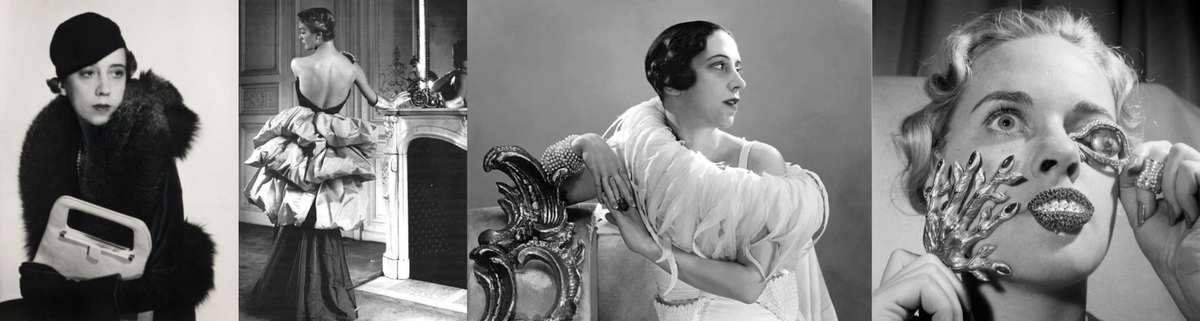
Elsa Schiaparelli (1890–1973) was an Italian-born fashion designer who became one of the most daring and innovative figures in the history of haute couture. Known for her bold creativity and provocative designs, she transformed fashion into a form of artistic expression.
While designers like Gabrielle Chanel and Madeleine Vionnet focused on elegance and simplicity, Schiaparelli pushed the limits of fashion by incorporating surrealism, humor, and unexpected materials into her designs. Her creations blended art and clothing, making her a pioneer of conceptual fashion.
Her famous inventions include the vibrant “Shocking Pink”, trompe-l'œil knitwear, surrealist accessories, and theatrical fashion shows.
Early Life and Influences
Elsa Schiaparelli was born on September 10, 1890, in Rome, in the Palazzo Corsini, into an aristocratic and intellectual family. Her father was an orientalist scholar, and her uncle, the astronomer Giovanni Schiaparelli, famously mapped the surface of Mars.
From a young age, Schiaparelli showed a rebellious personality. She studied philosophy and wrote sensual poetry that shocked her conservative family. As punishment, she was sent to a convent, where she reportedly went on a hunger strike in protest.
Seeking independence, she moved to London in the early 1910s. There she met and married Count Wilhelm de Wendt de Kerlor, a theosophist. The couple later moved to the United States and had a daughter.
Their marriage eventually ended when her husband left her for the famous dancer Isadora Duncan.
After separating from him, Schiaparelli moved to Paris, where she would completely reinvent her life.
The Beginning of Her Fashion Career
Although she did not initially know how to sew, Schiaparelli developed a fascination with fashion after meeting the renowned couturier Paul Poiret, who encouraged her creative instincts.
In 1927, she launched her career from a small apartment in Paris. Her first success came from hand-knitted sweaters with trompe-l'œil patterns, including a famous black sweater with a white bow illusion.
These designs quickly caught the attention of fashion buyers and magazines such as Vogue, launching her career internationally.
Soon after, she opened her boutique “Schiaparelli - Pour le Sport” at 4 Rue de la Paix in Paris, expanding her designs to include full collections.
Surrealism and Artistic Collaborations
Schiaparelli’s work became increasingly experimental in the 1930s, when she collaborated with surrealist artists such as:
- Salvador Dalí
- Jean Cocteau
- Alberto Giacometti
These collaborations resulted in some of the most iconic pieces in fashion history, including:
- the Lobster Dress, worn by Wallis Simpson
- the Shoe Hat, inspired by Dalí’s surrealist imagery
- embroidered garments with celestial constellations
Her designs often featured unusual motifs such as insects, skeletons, circus imagery, and trompe-l'œil illusions.
She also designed clothing for famous women of the time, including:
- Marlene Dietrich
- Greta Garbo
- Lauren Bacall
- Amelia Earhart
Innovation and Iconic Creations
Schiaparelli introduced numerous innovations in fashion, including:
- The jupe-culotte (divided skirt)
- Decorative zippers used as design elements
- Trompe-l'œil knitwear
- Exaggerated shoulders
- The famous color Shocking Pink
Her perfume Shocking, launched in 1937, featured a bottle shaped like a female torso inspired by the Hollywood icon Mae West.
She also transformed fashion shows into theatrical events with themes such as:
- Stop, Look and Listen
- Pagan
- Zodiac
- Circus
The Circus collection (1938) became one of her most famous shows, featuring embroidered elephants, acrobats, and clown-inspired accessories.
World War II and Later Career
During World War II, Schiaparelli moved to the United States and gave lectures titled “Clothes Make the Woman.”
After the war, she returned to Paris and resumed her work. However, the fashion world had changed dramatically with the arrival of Christian Dior and his revolutionary New Look, which dominated the postwar fashion industry.
Facing financial difficulties, Schiaparelli closed her couture house in 1954.
She later published her autobiography “Shocking Life” and continued promoting her perfumes until the end of her life.
Elsa Schiaparelli died in Paris on November 13, 1973.
Limits and Criticism
Despite her brilliance, Schiaparelli’s career also had limitations.
First, many of her designs were considered too eccentric or impractical for everyday wear. While they attracted attention and artistic admiration, they did not always translate into commercial success.
Second, her experimental approach made it difficult to compete with designers who focused on elegance and wearability, such as Christian Dior.
Finally, because she lacked formal training in couture, some critics initially questioned her legitimacy as a fashion designer.
However, these same qualities, experimentation and artistic freedom, are precisely what make her work so influential today.
Legacy
Today, Elsa Schiaparelli is recognized as one of the most innovative designers of the 20th century.
Her fusion of art and fashion paved the way for designers such as:
- Yves Saint Laurent
- Jean-Paul Gaultier
Her designs are now preserved in major museums such as the The Metropolitan Museum of Art and the Victoria and Albert Museum.
The fashion house Schiaparelli has also been revived in recent years, continuing her tradition of bold creativity.
My Thoughts
Personally, I find Elsa Schiaparelli fascinating because she treated fashion as a form of artistic experimentation rather than simply clothing.
What I admire most is her courage to challenge conventions. At a time when fashion was expected to follow strict rules of elegance, she embraced humor, surrealism, and even shock value.
Her work shows that creativity often comes from crossing boundaries between different artistic disciplines. By collaborating with painters and sculptors, she proved that fashion can be just as expressive and imaginative as any other art form.
For me, Schiaparelli represents the idea that fashion is not only about beauty but also about ideas, storytelling, and personality.
See you in the next one,
Eden.
Recources:
- Wikipedia: Elsa_Schiaparelli
- Musée de l’histoire de l’immigration : elsa-schiaparelli
- Victoria and Albert museum: elsa-schiaparelli
- The metropolitan museum: elsa-schiaparelli-1890-1973
Photos: