Fashion References Explained: The Art Behind Fashion's Most Iconic Collections

Fashion has never existed in isolation. Throughout history, designers have borrowed ideas from painting, sculpture, architecture, music, and literature to create garments that transcend clothing and become cultural statements.
Today, this relationship is stronger than ever. Recent Resort collections from Gucci, Dior, and Louis Vuitton have demonstrated how luxury fashion is increasingly embracing fine art, cultural institutions, and historical references. In an era dominated by algorithms, fast content, and artificial intelligence, artistic knowledge has become a powerful symbol of creativity and cultural value.
But fashion's relationship with art is not new. It has been evolving for more than a century.
The Birth of Art × Fashion Collaborations
Paul Poiret and Raoul Dufy
One of the earliest examples of a fashion designer collaborating with an artist dates back to 1910.
French couturier Paul Poiret, often called "The King of Fashion," hired Fauvist painter Raoul Dufy to create printed textiles for his couture house. Dufy's vibrant paintings of regattas, orchestras, and seaside leisure scenes were transformed into wearable works of art.
Poiret famously wrote in his memoir:
"Am I a fool when I dream of putting art into my dresses?"
For Poiret, dressmaking and painting were simply different expressions of the same artistic language.
Surrealism Enters Fashion
Elsa Schiaparelli × Salvador Dalí
If one collaboration changed the history of fashion forever, it was the partnership between Elsa Schiaparelli and Salvador Dalí.
United by their love of Surrealism, they transformed clothing into artistic statements that challenged traditional beauty and practicality.
Most Famous Creations
- Lobster Dress (1937)
- Tears Dress
- Shoe Hat
- Telephone Compact Powder Case
The iconic Lobster Dress featured a giant painted lobster inspired by Dalí's artwork "Lobster Telephone."
Their collaboration established the blueprint for future designer-artist partnerships.
Yves Saint Laurent and the Museum Wardrobe
No designer referenced art more consistently than Yves Saint Laurent.
Rather than simply printing paintings onto clothing, Saint Laurent studied artistic movements and translated them into fashion through craftsmanship and construction.
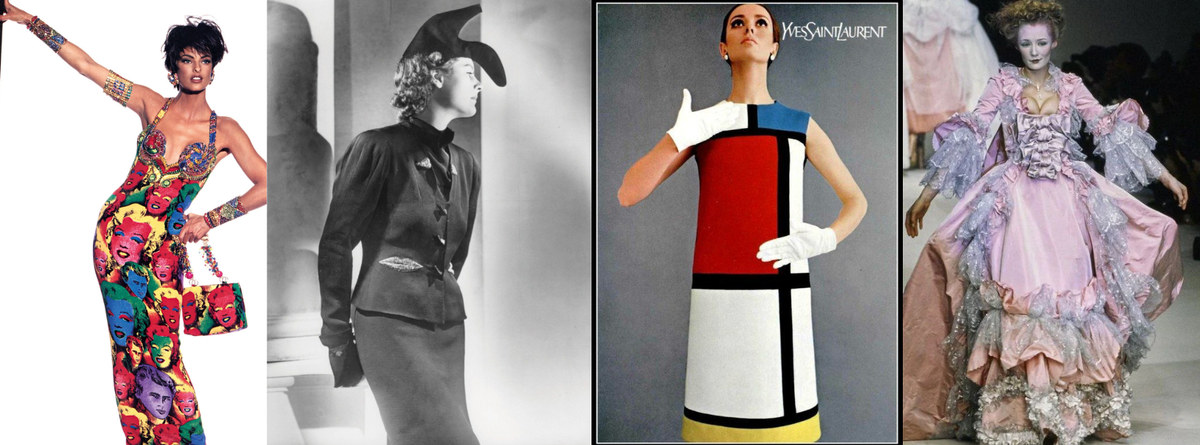
Piet Mondrian (1965)
Saint Laurent's Mondrian Dresses transformed Piet Mondrian's geometric paintings into minimalist shift dresses.
The dresses appeared simple but required extraordinary technical precision to maintain perfectly aligned lines and colour blocks.
Pop Art and Tom Wesselmann (1966)
Inspired by American Pop Art, Saint Laurent explored bold colour blocking and graphic cut-out effects.
Pablo Picasso (1979)
Drawing inspiration from Picasso's paintings and his work with the Ballets Russes, Saint Laurent created harlequin-inspired garments and recreated elements from Picasso's Portrait de Nusch Éluard.
Henri Matisse and Fernand Léger (1981)
Romanian folk blouses inspired by Matisse's La Blouse Roumaine appeared alongside colorful designs referencing Léger's Cubist-inspired compositions.
Vincent Van Gogh (1988)
Perhaps his most spectacular artistic tribute.
Using the expertise of Maison Lesage, Saint Laurent recreated Van Gogh's Sunflowers and Irises through embroidery.
Some jackets required:
- 600+ hours of work
- 250,000 sequins
- 22 different colors
These pieces are now considered museum-worthy fashion masterpieces.
Pop Art, Celebrity Culture, and Fashion
Gianni Versace × Andy Warhol
In 1991, Gianni Versace merged fashion, celebrity culture, and Pop Art.
Featuring Warhol's portraits of Marilyn Monroe and James Dean, the collection reflected both men's fascination with fame, repetition, and media culture.
The collection remains one of fashion's most recognizable artistic collaborations.
Vivienne Westwood and Historical Art
While many designers looked toward modern artists, Vivienne Westwood often looked backward.
The Wallace Collection
Westwood repeatedly drew inspiration from London's Wallace Collection, particularly the work of Rococo painter François Boucher.
Her famous Portrait Collection (1990) featured:
- Corsets
- Dresses
- Historical prints
directly inspired by Boucher's paintings.
Westwood famously said she wanted her models to look as though they had stepped out of a portrait.
Today, those printed corsets remain among the house's most recognisable designs.
Jewellery as Artistic Storytelling
The 2026 exhibition "Vivienne Westwood & Jewellery" in Macau highlights four decades of jewellery design.
Creative director Andreas Kronthaler describes the jewellery as an extension of Westwood's rebellious spirit, featuring everything from hand-beaded necklaces to papier-mâché tiaras.
The exhibition demonstrates how fashion accessories can carry the same artistic and cultural significance as paintings or sculptures.
Japanese Artists Transform Luxury Fashion
Louis Vuitton × Takashi Murakami
One of the most commercially successful collaborations in fashion history.
Marc Jacobs invited Japanese artist Takashi Murakami to reinvent Louis Vuitton's monogram.
The result:
- Multicolored monograms
- Smiling flowers
- Cherries
- Fantasy characters
The collection sold out almost immediately and became a defining symbol of early-2000s fashion.
Louis Vuitton × Yayoi Kusama
Another landmark collaboration.
Kusama's iconic polka dots appeared across:
- Handbags
- Dresses
- Accessories
The collaboration successfully brought contemporary art into mainstream luxury fashion.
Contemporary Art on the Runway
Fashion continues to engage with contemporary artists today.
Issey Miyake × Yasumasa Morimura
Morimura's reinterpretations of classical paintings became wearable artworks through Miyake's innovative Pleats Please line.
Raf Simons × Brian Calvin
Simons integrated Calvin's unsettling portraits into menswear, blurring the line between fashion and contemporary art.
Valentino × Hieronymus Bosch
Pierpaolo Piccioli referenced Bosch's The Garden of Earthly Delights to create dreamlike, ethereal gowns.
Diotima × Wifredo Lam
Rachel Scott collaborated directly with the estate of Cuban artist Wifredo Lam, transforming his paintings into garments while preserving their cultural significance.
Why Fashion Is Looking Toward Art Again
Recent Resort collections from Gucci, Dior, and Louis Vuitton suggest a growing trend.
Designers are increasingly emphasizing:
- Museum partnerships
- Historical references
- Artistic legitimacy
- Cultural storytelling
In today's digital environment, where trends move faster than ever, artistic knowledge functions as a form of cultural capital.
Fashion houses are no longer simply selling products.
They are selling narratives, intellectual references, and creative identities.
The Limits of Art-Inspired Fashion
While art-inspired fashion can be beautiful and educational, it is important to acknowledge its limitations.
Commercialisation of Art
Critics argue that some collaborations reduce complex artworks into luxury products.
A painting created to challenge society can become an expensive handbag accessible only to a privileged audience.
Superficial References
Not every artistic reference is deeply researched.
Some collections use famous artworks primarily for visual appeal rather than engaging with their historical or cultural significance.
Accessibility Issues
Luxury fashion often turns cultural heritage into products priced beyond the reach of most consumers.
This raises questions about who gets access to art and cultural knowledge.
Risk of Overshadowing the Artist
Sometimes the designer receives more recognition than the artist whose work inspired the collection.
As collaborations become more commercial, maintaining balance and respect for artistic contributions becomes increasingly important.
My Thought
What fascinates me most about the relationship between fashion and art is that it proves clothing can communicate far more than trends or status. The most memorable collections are often the ones that teach us something new, about an artist, a historical period, or a cultural movement.
I believe fashion is at its strongest when it acts as a bridge between different creative disciplines. Seeing a Mondrian painting transformed into a dress or a Dalí surrealist concept become wearable art reminds us that creativity has no boundaries.
At the same time, fashion must be careful not to reduce art to a marketing tool. The most successful collaborations are those built on genuine admiration, research, and respect for the original artwork.
Ultimately, fashion and art share the same goal: helping us see the world differently.
Resources:
- Vogue: gucci-dior-and-louis-vuitton-lean-deeply-into-art-for-their-resort-collections
- The Rose period: 3-art-x-fashion-collabs-you-need
- Tatler: andreas-kronthaler-vivienne-westwood-jewellery-macau
- W Magazine: fashion-art-world-references-met-gala-2026
- Coveteur: fashion-and-art-met-gala-2026
Photo: