Louis Vuitton

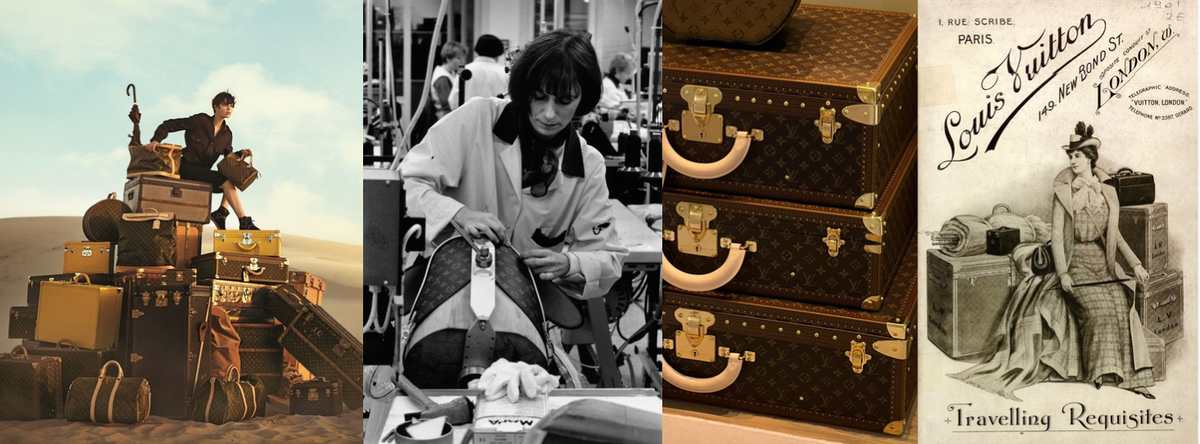
Louis Vuitton was born on August 4, 1821, in eastern France, into a modest family of artisans. His childhood was marked by hardship: his mother died when he was just 10, and his relationship with his stepmother was difficult. At only 13 years old, he left home and walked nearly 470 kilometers to Paris.
Arriving in 1837, during the Industrial Revolution, he began working as an apprentice for Romain Maréchal, a respected trunk maker. This experience introduced him to a highly specialised craft: designing and packing custom-made luggage for elite clients.
The Birth of a Craftsman
Louis Vuitton quickly gained recognition for his precision and creativity. His big breakthrough came when he was appointed personal trunk maker to Eugénie de Montijo, wife of Napoleon III.
This prestigious position opened doors to aristocratic and royal clients, establishing Vuitton as one of the most sought-after craftsmen in Paris.
Founding of the Louis Vuitton Brand
In 1854, Vuitton founded his own company near Place Vendôme in Paris. His workshop specialized in securely packing fragile and fashionable items.
A Revolutionary Innovation
In 1858, he introduced a groundbreaking product: the flat-top rectangular trunk.
Unlike traditional rounded trunks, Vuitton’s design allowed for easy stacking, perfectly suited for modern transportation like trains and ships. He also replaced heavy leather with lightweight, waterproof canvas.
This innovation transformed travel and set the foundation for modern luggage design.
The Asnières Workshop
In 1859, Vuitton expanded his operations by opening a workshop in Asnières-sur-Seine.
- Started with 20 artisans
- Grew to over 200 employees by 1914
- Combined family residence and production site
Today, the workshop still produces exclusive, handcrafted items and houses the Louis Vuitton Museum, preserving the brand’s heritage.
Innovation and Expansion
- Signature Designs
- 1872: striped canvas (red and beige)
- 1888: the iconic Damier checkerboard pattern
- Security Innovation
- In 1886, Louis Vuitton and his son Georges Vuitton developed the revolutionary tumbler lock system.
- So secure that Georges famously challenged Harry Houdini to escape from it, he never accepted.
Challenges and Resilience
The Franco-Prussian War devastated Vuitton’s business:
- Workshop destroyed
- Tools stolen
- Demand collapsed
However, Vuitton rebuilt quickly, opening a new shop in Paris and continuing to innovate. This resilience became a defining feature of the brand.
From Family Business to Global Empire
After Vuitton’s death in 1892, Georges Vuitton expanded the brand internationally and created the famous LV monogram in 1896.
In 1987, the company merged with Moët Hennessy to form LVMH, now led by Bernard Arnault.
Louis Vuitton has since collaborated with influential designers such as:
- Marc Jacobs
- Virgil Abloh
- Pharrell Williams
Today, it is one of the most valuable luxury brands in the world.
Limits and Criticism
Despite its success, Louis Vuitton is not without criticism:
- Over-commercialisation
- The brand’s global expansion has led some critics to argue that it has lost part of its artisanal exclusivity.
- Counterfeiting
- Louis Vuitton is one of the most counterfeited brands in the world, which paradoxically reflects both its popularity and vulnerability.
- Luxury and Accessibility
- Its high prices raise questions about accessibility and the growing gap between luxury and everyday consumers.
- Environmental Concerns
- Like many luxury brands, it faces increasing scrutiny over sustainability, production practices, and environmental impact.
My Thought
What fascinates me about Louis Vuitton is how a story that started with a young boy walking alone to Paris became one of the most powerful luxury empires in the world.
But what I find even more interesting is the contrast:on one hand, there is true craftsmanship, innovation, and heritage;on the other, there is mass global branding and commercialization.
To me, Louis Vuitton represents both the beauty and the limits of modern luxury: it is a symbol of creativity and success, but also a reminder that growth can sometimes distance a brand from its original identity.
Resources:
- Wikipedia : Louis_Vuitton_(designer)
- Louis Vuitton: a-legendary-history
- Britannica: Louis-Vuitton-designer
Photos: