One Garment, One History: The White Shirt

Some garments come and go with changing trends. Others transcend generations and become permanent fixtures of our wardrobes. The white shirt belongs firmly to the second category.
Simple, elegant, and endlessly adaptable, the white shirt has been worn by queens, writers, revolutionaries, Hollywood stars, fashion designers, and everyday people alike. Yet behind its apparent simplicity lies a fascinating history that touches on class, gender, labor, culture, and even some of the darker chapters of human history.
Today, the white shirt is considered a universal fashion essential. But how did a humble undergarment become one of the most influential pieces of clothing ever created?
From Underwear to Status Symbol
The origins of the white shirt can be traced back thousands of years. Ancient civilizations such as Egypt, Greece, and Rome wore simple tunic-like garments made from linen, many of which naturally appeared white or off-white.
For centuries, however, shirts were primarily considered undergarments. They were worn beneath more elaborate clothing and rarely displayed in public.
During the Middle Ages and Renaissance, the white shirt became a symbol of wealth and refinement. Keeping a garment clean and bright white required significant resources and frequent laundering, something only the upper classes could afford.
The color white itself became associated with:
- Purity
- Respectability
- Wealth
- Social status
At the court of King Louis XIV, finely embroidered white shirts adorned with lace became symbols of aristocratic luxury.
In short, wearing a pristine white shirt communicated privilege before a single word was spoken.
Marie Antoinette and the Shirt That Changed Fashion
One of the most important moments in the history of the white shirt occurred in 1783.
In a portrait painted by Madame Vigée-Lebrun, Marie Antoinette appeared wearing a simple white cotton garment known as a "chemise à la reine" or "robe en gaulle."
The portrait shocked European society.
Instead of appearing in luxurious silk and jewels, the Queen of France was shown in what many considered little more than elegant underwear. The dress was loose, lightweight, and made from cotton rather than expensive silk.
The reaction was immediate. Some considered the outfit inappropriate for royalty, while others embraced its relaxed elegance.
The portrait transformed public taste and helped popularize cotton clothing throughout Europe.
The Hidden Cost of Cotton
This fashion moment also reveals one of the darker realities behind the white shirt's history.
As cotton became increasingly fashionable, demand skyrocketed. The rapid growth of cotton production relied heavily on enslaved labor, particularly in the American South.
Historian Caroline London described this process as a "perfect storm":
- Fashion made cotton desirable.
- Technological advances made it easier to produce.
- Slave labor made it affordable.
As demand increased, cotton production expanded dramatically, strengthening an economic system built on human exploitation.
The white cotton garments we now associate with elegance therefore carry a complex legacy that cannot be ignored. Understanding fashion history also means acknowledging the human cost that sometimes made these trends possible.
The White Shirt Becomes a Modern Uniform
Throughout the 19th century, the white shirt evolved from undergarment to visible outerwear.
For men, it became the foundation of formal dress and was paired with tailored suits and detachable collars.
The garment also became closely associated with intellectual and professional work.
Writers, businessmen, politicians, and lawyers adopted the white shirt as a symbol of discipline and respectability.
This distinction eventually gave rise to the term "white-collar worker," used to describe office employees in contrast to "blue-collar" manual laborers.
The white shirt became a visual marker of professional success and social mobility.
Women Reclaim the White Shirt
For centuries, the white shirt was largely reserved for men.
That changed dramatically during the early 20th century.
As women entered the workforce and social expectations evolved, designers began incorporating traditionally masculine garments into womenswear.
Among the most influential figures was Coco Chanel, who challenged restrictive dress codes by introducing more practical and relaxed clothing for women.
The white shirt became a symbol of liberation.
Women exchanged corsets for comfort and embraced clothing that allowed greater freedom of movement.
By the 1920s and 1930s, the white shirt had become a wardrobe staple for modern women.
Hollywood Creates an Icon
If designers introduced the white shirt to women, Hollywood turned it into a cultural phenomenon.
Some of cinema's most stylish women embraced it:
- Katharine Hepburn
- Marlene Dietrich
- Lauren Bacall
- Ava Gardner
One of the most memorable examples came from Audrey Hepburn in Roman Holiday, where her rolled-up white shirt became a symbol of effortless elegance.
At this stage, the shirt was often styled in a feminine way:
- Cinched at the waist
- Paired with skirts
- Worn with silk scarves
- Left slightly unbuttoned
It represented sophistication while remaining approachable.
The Rise of Androgyny
By the 1970s and 1980s, the white shirt acquired a new identity.
It became a symbol of androgyny, rebellion, and individuality.
Few images capture this better than the famous cover of Horses by Patti Smith.
Wearing a slightly wrinkled white shirt, skinny tie, and black trousers, Smith blurred traditional boundaries between masculine and feminine style.
Other influential examples include:
- Diane Keaton in Annie Hall
- Kim Basinger in 9½ Weeks
- Uma Thurman in Pulp Fiction
The white shirt was no longer simply elegant, it became expressive.
The Runway Reinvention
Fashion designers have repeatedly reinvented the white shirt.
Minimalist labels such as Calvin Klein and DKNY made it a cornerstone of 1990s fashion.
Later, designers including Phoebe Philo at Celine and Jil Sander elevated it through clean tailoring and minimalist design.
Today, brands continue to reinterpret the classic shirt through:
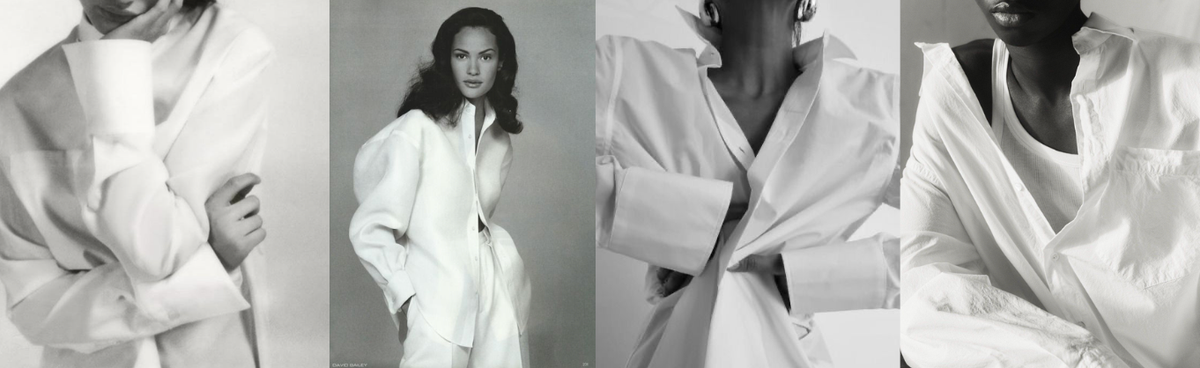
- Oversized silhouettes
- Exaggerated collars
- Puff sleeves
- Crisp cottons
- Fluid silks
- Relaxed linen constructions
The design changes, but the essence remains.
Why the White Shirt Never Goes Out of Style
Few garments possess the versatility of the white shirt.
It works with:
- Tailored suits
- Denim jeans
- Evening skirts
- Shorts
- Knitwear
- Dresses
It moves effortlessly between:
- Work and leisure
- Formal and casual
- Masculine and feminine
- Traditional and contemporary
Fashion experts often describe it as a blank canvas, a garment capable of reflecting the personality of whoever wears it.
That adaptability explains why it has survived every major fashion cycle.
The Limits of the White Shirt
Although the white shirt is often celebrated as a universal classic, it is important to recognise its limitations.
A History Rooted in Privilege
For centuries, white shirts symbolised wealth because only affluent individuals could maintain them.
Connections to Slavery
The rise of cotton production was deeply linked to systems of exploitation and slavery.
Sustainability Concerns
Today, cotton remains one of the world's most resource-intensive crops. Conventional cotton farming requires significant amounts of water and can involve harmful pesticides.
As consumers become more environmentally conscious, the future of the white shirt depends not only on style but also on responsible production.
Fashion history is rarely entirely positive, and understanding both the beauty and the complexity of iconic garments allows us to appreciate them more honestly.
My Thought
What fascinates me most about the white shirt is how a garment so simple can contain so many stories. It has been worn by queens, artists, office workers, movie stars, and rebels. It has represented privilege, professionalism, freedom, sensuality, and creativity.
At the same time, its history reminds us that fashion is never isolated from society. The popularity of cotton, for example, cannot be discussed without acknowledging the role slavery played in its expansion.
Perhaps this is why the white shirt remains so relevant today. It is more than just a piece of clothing, it is a reflection of the changing values, ambitions, and contradictions of every era that has worn it.
More than two centuries after Marie Antoinette shocked Europe with a simple cotton dress, the white shirt continues to evolve while remaining unmistakably itself. Few garments can claim such a remarkable legacy.
Resources:
- Harper’s Bazzar: history-white-shirt
- Oliver Spencer: the-history-of-the-white-shirt-a-timeless-tale-of-elegance-and-evolution
- Bourrienne: la-chemise-blanche-de-l-uniforme-au-symbole-de-liberte
- Nieuwe Instituut: https://nieuweinstituut.nl/en/projects/tijdelijk-modemuseum/white-shirt
Photos: