Azzedine Alaïa: The Couturier of Precision

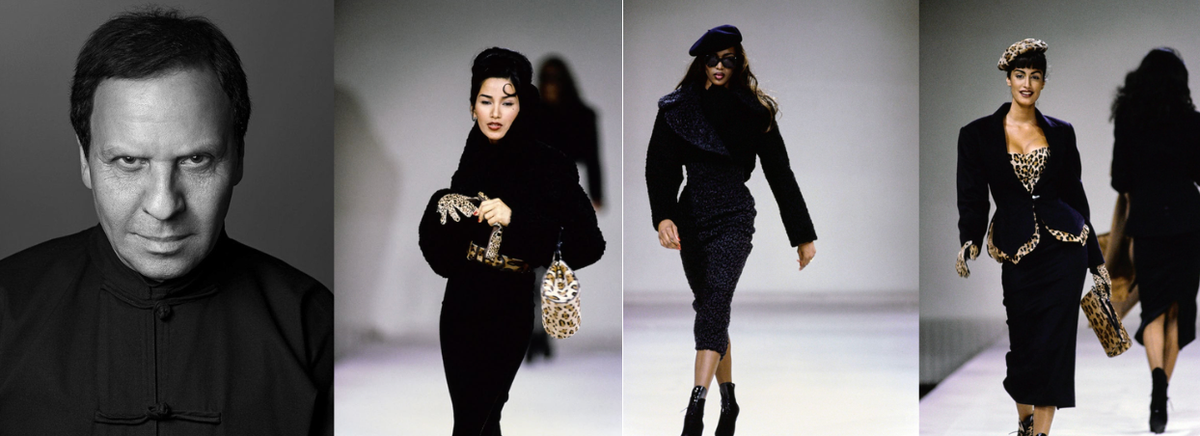
Few designers in fashion history have shaped the female silhouette with as much precision, sensuality, and devotion as Azzedine Alaïa. Often described as “the couturier’s couturier,” Alaïa built a career outside the conventions of the fashion system, refusing the pressure of official calendars and trends in favor of timeless craftsmanship.
The exhibition Azzedine Alaïa: The Couturier, conceived by Alaïa himself before his death in November 2017, celebrates this extraordinary legacy. Presented at the Design Museum in London, it brought together more than sixty silhouettes tracing his career from the early 1980s to his final collection in 2017. Co-curated with Mark Wilson, the exhibition highlighted not only Alaïa’s technical genius, but also his humanity, artistic influences, and obsession with perfection.
As Wilson explained:
“He loved women. He wanted them to look incredible… to feel confident, and that’s why women loved him.”
The Outsider of Fashion
Unlike many of his contemporaries, Alaïa operated outside the traditional fashion system. While most luxury houses followed strict seasonal calendars, he chose to work at his own rhythm.
Always dressed in his signature black clothing, Alaïa cultivated the image of a quiet outsider. Yet behind this reserved appearance was a designer deeply committed to Haute Couture traditions. Every garment was draped, cut, pinned, and adjusted by his own hands.
He once stated:
“I refuse to do things that I don’t want to. I do what I want. I am free.”
This independence became one of the defining aspects of his legacy. From his first runway show in 1987 to his last collection in 2017, Alaïa proved that fashion could exist outside industrial speed and still remain influential.
However, this refusal of the system also had limitations. Alaïa’s resistance to fashion calendars sometimes reduced the commercial visibility of his collections compared to larger global luxury brands. In an industry increasingly dominated by marketing and rapid consumption, his slow and perfectionist approach was difficult to sustain economically.
Still, this very independence is what made his work timeless.
Sculpting the Female Body
Originally trained as a sculptor at the School of Fine Arts in Tunis, Alaïa approached fashion as if he were shaping marble or clay.
Art came before fashion for him. He believed garments should sculpt the body while remaining sensual and fluid. This philosophy led to his famous “second-skin” silhouettes and earned him the nickname:
“The King of Cling.”
His body-conscious dresses transformed stretch fabrics, leather, velvet, and chiffon into architectural forms. Instead of hiding the body, Alaïa celebrated it.
He famously declared:
“I make clothes, but women make fashion.”
This intimate understanding of women attracted iconic clients and muses including Grace Jones, Michelle Obama, Rihanna, Lady Gaga, and Naomi Campbell.
Yet Alaïa’s idealized silhouettes have also been criticized. His hyper-fitted garments often emphasized a narrow body ideal associated with the supermodel culture of the 1980s and 1990s. While his designs empowered many women, they could also feel inaccessible to others whose bodies did not fit fashion’s traditional standards.
This contradiction reflects a broader tension within luxury fashion: celebrating the body while simultaneously reinforcing ideals of perfection.
The Revolutionary Use of Materials
Leather Reimagined
Alaïa revolutionized the use of leather in fashion. Traditionally associated with rebellion or masculinity, he transformed it into something elegant, delicate, and sensual.
He manipulated leather like chiffon:
- perforating it,
- laser-cutting it,
- softening it,
- and sculpting it into feminine silhouettes.
His iconic 1981 leather coat covered with eyelets announced the sharp, powerful aesthetic that would define the decade.
Stretch Fabrics and the Bandage Dress
One of Alaïa’s greatest innovations was his mastery of stretch materials. His famous Bandelette dresses, introduced in 1986, wrapped around the body like bandages or ancient Egyptian textiles.
These garments were technically complex despite appearing simple. Every strip of fabric was engineered according to its exact place on the body.
This approach would later inspire the entire bodycon movement of the 1990s.
Metal, Chiffon, and Velvet
Alaïa constantly challenged the limits of materials:
- metal became transparent like fabric,
- chiffon became sharp and powerful,
- velvet became light and modern.
For Alaïa, materials themselves could generate form:
“Material can trigger a form.”
This obsession with craftsmanship made his garments almost architectural.
Fashion as Architecture
Alaïa often compared his work to architecture rather than fashion. He considered himself a builder of garments.
His exploration of volume reflected his admiration for designers such as Cristóbal Balenciaga, Madeleine Vionnet, and Charles James.
Rather than relying on heavy corsetry or petticoats, Alaïa manipulated fabric itself to create dramatic forms that floated around the body.
The exhibition showcased:
- sculptural ball gowns,
- exaggerated silhouettes,
- Renaissance-inspired velvets,
- and dramatic black chiffon dresses.
His work blurred the boundaries between fashion, sculpture, and industrial design.
Black: Alaïa’s Signature Color
Although Alaïa used subtle tones such as camel, olive, burgundy, and teal, black remained central to his aesthetic.
He once said:
“I like black, because for me, it’s a very happy colour.”
For Alaïa, black removed distractions. It emphasized structure, silhouette, and craftsmanship. Black also shifted attention away from the garment and toward the woman wearing it.
Ironically, this minimalism often concealed the immense labor behind his creations. The simplicity of his dresses masked hours of technical construction invisible to the eye.
Cultural Influences and Artistic Inspirations
Alaïa’s work was deeply influenced by:
- North African culture,
- Spanish art,
- ancient civilizations,
- and sculpture.
His perforated fabrics recalled the mashrabiya screens of Arab architecture. His dramatic volumes referenced Spanish court dress and the paintings of Diego Velázquez.
Africa remained a major source of inspiration throughout his career. Animal patterns, raffia, flax rope, shells, and crocodile skin reflected both the reality and fantasy of the continent.
Importantly, Alaïa approached these inspirations through personal memory rather than exotic spectacle. His Tunisian heritage shaped his understanding of climate, movement, and clothing functionality.
Still, discussions around cultural inspiration in fashion today also invite more critical reflection. Modern audiences increasingly question where the line exists between appreciation and appropriation. Although Alaïa’s relationship to these references was deeply personal, contemporary readers may still interpret some uses of African imagery through a more critical lens.
Timelessness Against Fast Fashion
Perhaps Alaïa’s greatest achievement was timelessness.
His garments rarely appear dated because he never designed for trends. Instead, he focused on:
- proportion,
- sensuality,
- craftsmanship,
- and permanence.
Mark Wilson described this quality perfectly:
“You can’t time his clothes. They could have been made in the future or the past.”
In today’s fashion landscape dominated by fast fashion, digital virality, and constant trend cycles, Alaïa’s philosophy feels almost radical. His work reminds audiences that true luxury is not speed, but precision and longevity.
However, this timelessness also belongs to a rarefied world of luxury inaccessible to most consumers. Alaïa’s couture-level craftsmanship required extraordinary time, labor, and cost, realities that stand in contrast with contemporary demands for accessibility and mass production.
The Exhibition: A Dialogue Between Fashion and Design
The exhibition itself was conceived as more than a retrospective. Alaïa collaborated with designers and artists including:
- Marc Newson,
- Ronan Bouroullec,
- Erwan Bouroullec,
- Konstantin Grcic,
- and Kris Ruhs.
Large architectural screens surrounded the garments, transforming the exhibition space into an immersive artistic environment.
Photography by Richard Wentworth documented Alaïa’s working process, revealing the patience and intimacy behind each creation.
The exhibition became not only a tribute to fashion, but also to friendship, collaboration, and artistic devotion.
Conclusion
Azzedine Alaïa remains one of fashion’s most respected figures because he never compromised his vision.
He resisted trends, rejected industrial speed, and devoted himself entirely to the female body and the art of construction. His garments were not simply clothes, they were sculptural objects balancing strength and fragility, sensuality and discipline, tradition and innovation.
More than anything, Alaïa proved that fashion could transcend time.
My Thought
What fascinates me most about Alaïa is his obsession with precision and permanence in an industry built on constant change. Today fashion often moves so quickly that garments are consumed like temporary images online, but Alaïa worked differently. Every seam, every cut, every material had meaning.
I also admire the emotional relationship he had with women. His goal was never simply to impress critics or create trends, it was to make women feel powerful and beautiful. That sincerity is probably why his clothes still feel modern decades later.
At the same time, I think it is important to recognize the contradictions within his legacy. Alaïa celebrated women, but many of his silhouettes still reflected fashion’s narrow beauty standards. His craftsmanship was extraordinary, yet accessible only to a privileged few. These tensions do not diminish his genius, but they remind us that even the greatest designers exist within the limits of the fashion system.
Still, Alaïa’s work feels increasingly important today. In an era dominated by fast fashion and digital overconsumption, his dedication to time, craftsmanship, and artistic integrity feels almost revolutionary.
Ressources:
- Foundation Azzedine Alaïa: https://fondationazzedinealaia.org/expositions/azzedine-alaia-the-couturier/
- Forc Magazine: azzedine-alaia-the-couturier
- Vogue: azzedine-alaia-the-couturier-exhibition-design-museum
Photos: